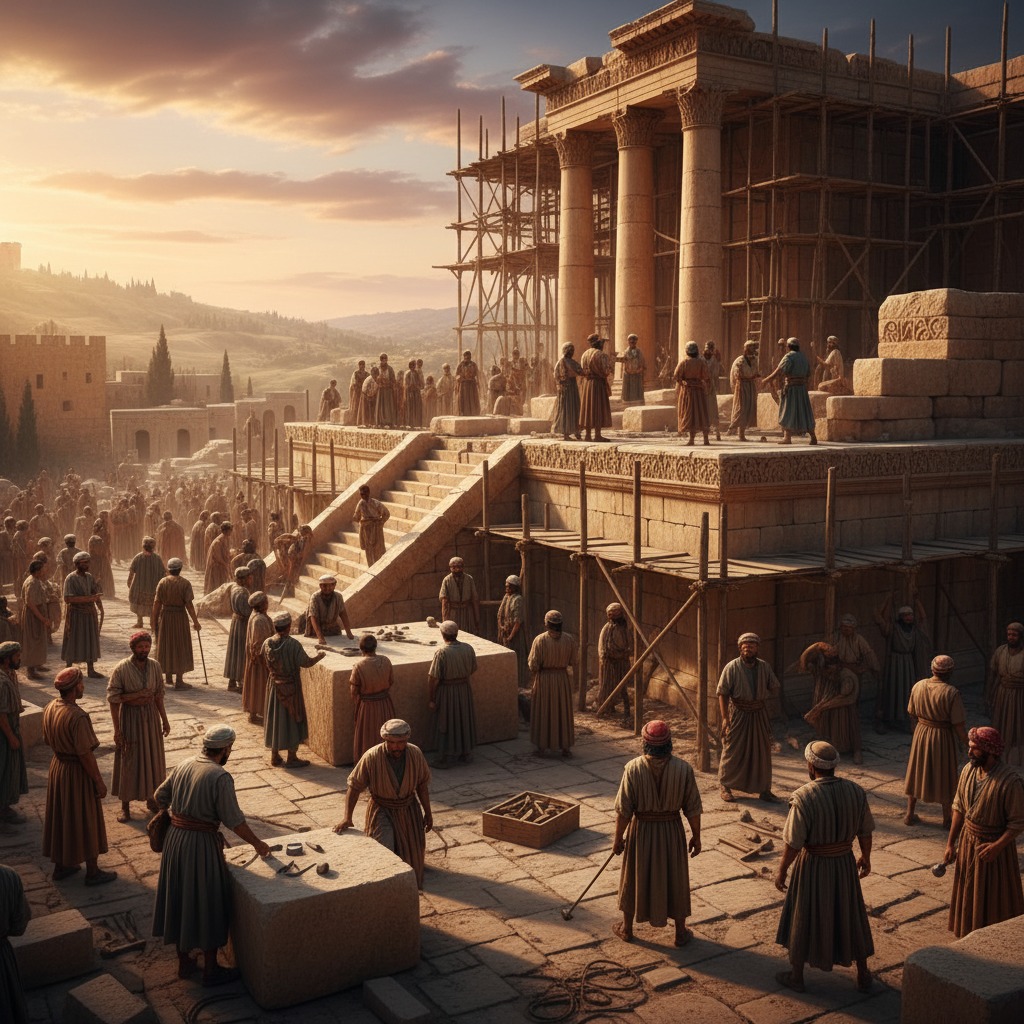
A STORY OF FAITH, RESTORATION AND THE FULFILLMENT OF PROPHECY
JERUSALEM, JUDEA — THE REBUILDING OF THE TEMPLE IN JERUSALEM followed its destruction by Babylon in 586 BC. This moment marked a turning point for communal worship and shared identity.
Additionally, after decades of captivity and exile, Jewish people were offered the chance to return and restore sacred place. The biblical narrative underscored hope for renewal. Together, these events shaped prayer, ritual, and expectation for future generations. Thus, communities prepared for the long journey back.
The rebuilding of the Temple was more than an architectural project. It represented the restoration of a nation, the renewal of faith, and the fulfillment of God’s promises through His prophets.
The events are recorded primarily in the books of Ezra, Haggai, Zechariah, and Nehemiah.
The Destruction of Solomon’s Temple
The First Temple in Jerusalem was built by King Solomon, the son of David. It became the central place of worship for the people of Israel and housed the Ark of the Covenant.
However, the spiritual decline of the nation and its repeated disobedience to God’s commandments preceded a period of judgment and national catastrophe.
In 586 BC, the Babylonian army, led by King Nebuchadnezzar II, conquered Jerusalem, destroyed the Temple, burned important buildings, and carried many inhabitants into captivity in Babylon.
The destruction marked one of the darkest moments in the history of the kingdom of Judah.
“And he burnt the house of the LORD, and the king’s house, and all the houses of Jerusalem.”
— 2 Kings 25:9 (KJV)
With the Temple destroyed and the people taken into exile, Jerusalem was left devastated.
For the Jewish people, the loss of the Temple meant the loss of their central place of worship. Moreover, it was one of the most important symbols of their national and spiritual identity.
The Return from Babylonian Exile
A decisive turning point came after the Persian Empire conquered Babylon in 539 BC.
King Cyrus the Great issued a decree allowing the Jewish exiles to return to Jerusalem and rebuild the Temple of the LORD.
This decision represented a major turning point in Jewish history. After approximately seventy years of exile, a new opportunity for restoration emerged.
The decree of Cyrus is presented in the Book of Ezra as a moment through which God’s plan for His people began to unfold.
“Thus saith Cyrus king of Persia, The LORD God of heaven hath given me all the kingdoms of the earth; and he hath charged me to build him an house at Jerusalem, which is in Judah.”
— Ezra 1:2 (KJV)
Under the leadership of Zerubbabel, a descendant of the house of David, and Joshua, the high priest, groups of Jewish exiles returned to Jerusalem.
Their mission was clear: rebuild the altar, restore worship, and reconstruct the Temple.
The Foundation of the Second Temple Is Laid
After arriving in Jerusalem, the returning exiles began by rebuilding the altar of the God of Israel.
Sacrifices were offered, and worship was restored according to the Law of Moses.
The next major step was the reconstruction of the Temple.
The foundation was laid amid great celebration. The priests sounded their trumpets, the Levites played cymbals, and the people praised the LORD.
However, the atmosphere was filled with mixed emotions.
Many younger people celebrated the new beginning, while older individuals who had seen Solomon’s original Temple remembered its former glory and wept.
“But many of the priests and Levites and chief of the fathers, who were ancient men, that had seen the first house, when the foundation of this house was laid before their eyes, wept with a loud voice.”
— Ezra 3:12 (KJV)
The laying of the foundation marked the beginning of a new chapter, but the construction would soon face serious obstacles.
Opposition and Delays Halt the Construction

The rebuilding of the Temple did not proceed without opposition.
Local adversaries challenged the work, attempted to discourage the builders, and brought accusations against the Jewish community before the Persian authorities.
As a result, construction was interrupted for a period of time.
The people gradually became discouraged, and their attention shifted toward their own homes and everyday concerns rather than the rebuilding of God’s house.
For several years, the Temple remained unfinished.
The situation changed when God raised up two prophets: Haggai and Zechariah.
Their messages called the people back to their responsibility and reminded them that the work of rebuilding God’s house must not be abandoned.
The Prophets Haggai and Zechariah Call the People to Action

Around 520 BC, the prophets Haggai and Zechariah delivered powerful messages to the people of Judah.
Haggai confronted the people because they were neglecting the Temple while focusing on their own houses.
He challenged them to reconsider their priorities and return to the work God had entrusted to them.
“Is it time for you, O ye, to dwell in your cieled houses, and this house lie waste?”
— Haggai 1:4 (KJV)
The prophet also delivered a message of encouragement to Zerubbabel, the governor of Judah, and Joshua, the high priest.
God reminded them that the success of the rebuilding project would not depend merely on human strength or political influence.
“Not by might, nor by power, but by my spirit, saith the LORD of hosts.”
— Zechariah 4:6 (KJV)
These prophetic messages renewed the determination of the people.
Under the leadership of Zerubbabel and Joshua, construction resumed.
The Second Temple Is Complete
After years of difficulties, opposition, and delays, the reconstruction finally reached completion.
The Temple was completed in the sixth year of the reign of King Darius I of Persia, around 516 BC.
Its completion represented a great victory for the Jewish community.
The people celebrated the dedication of the Temple with joy, sacrifices, and thanksgiving to God.
Although the Second Temple was not as architecturally magnificent as Solomon’s original Temple, it restored Jerusalem’s central place of worship.
“And this house was finished on the third day of the month Adar, which was in the sixth year of the reign of Darius the king.”
— Ezra 6:15 (KJV)
The dedication of the Temple marked the end of a long period of restoration and the beginning of a new era in the life of the Jewish people.
The Prophetic Promise of Greater Glory
One of the most important messages associated with the rebuilding of the Temple came through the prophet Haggai.
Some of those who had seen the First Temple believed that the new building could never compare with the greatness of Solomon’s Temple.
In this context, God delivered a message of encouragement and hope, declaring that the glory of the latter house would be greater than that of the former.
“The glory of this latter house shall be greater than of the former, saith the LORD of hosts.”
— Haggai 2:9 (KJV)
This prophecy became one of the most significant declarations concerning the future of the Temple.
The Expansion of the Temple Under King Herod the Great
Several centuries after the reconstruction of the Second Temple, King Herod the Great initiated an extensive renovation and expansion project.
The work began around 20–19 BC and transformed the Temple into one of the most impressive architectural complexes of the ancient world.
The platforms were expanded, massive retaining walls were constructed, and monumental buildings were added.
This was the Temple that existed during the earthly ministry of Jesus Christ.
The Gospels repeatedly describe Jesus visiting the Temple in Jerusalem, teaching the people and speaking about true worship.
“My house shall be called the house of prayer.”
— Matthew 21:13 (KJV)
The Destruction of the Second Temple in AD 70
In AD 70, the history of the Temple in Jerusalem witnessed another tragedy.
During the Jewish revolt against the Roman Empire, the Roman army, led by General Titus, conquered Jerusalem and destroyed the Temple.
The event represented one of the most dramatic tragedies in Jewish history.
The destruction of the Temple fulfilled the warning Jesus had given concerning the future of Jerusalem.
“There shall not be left here one stone upon another, that shall not be thrown down.”
— Matthew 24:2 (KJV)
Since then, the Temple has never been rebuilt.
Today, the Western Wall, also known as the Wailing Wall, remains one of the most important historical remnants of Herod’s Temple complex.
The Spiritual Significance of the Rebuilding of the Temple
Beyond its historical dimension, the rebuilding of the Temple carries a profound spiritual message.
This story speaks of restoration, perseverance, faith, and returning to God.
The Jewish people experienced destruction, exile, discouragement, and opposition, but they were given another opportunity to rebuild what had been lost.
The messages of the prophets Haggai and Zechariah demonstrate that God’s work must not be abandoned in the face of difficulties.
For believers, the rebuilding of the Temple remains a lesson about the importance of spiritual priorities and God’s faithfulness to His promises.
CONCLUSION – A REBUILT TEMPLE, A RESTORED NATION
The rebuilding of the Temple in Jerusalem represents one of the most important moments in biblical history.
From the destruction of the First Temple by the Babylonians, to Cyrus’s decree, the return from exile, the messages of the prophets, and the completion of the Second Temple, the entire account reveals an extraordinary process of restoration.
Later, Herod’s expansion transformed the complex into a symbol of the greatness of ancient Jerusalem, before its destruction by the Romans in AD 70.
The Temple was destroyed, the people were taken into exile, but the hope of restoration never disappeared. The story of its rebuilding remains a testimony to faith, perseverance, and the fulfillment of God’s plan.
BIBLICAL SOURCES
2 Kings 25:8–10 – The destruction of Jerusalem and Solomon’s Temple.
2 Chronicles 36:17–23 – The Babylonian captivity and the decree of King Cyrus.
Isaiah 44:28–45:1 – The prophecy concerning Cyrus.
Ezra 1:1–11 – The decree of Cyrus and the return of the Jewish exiles.
Ezra 3:1–13 – The rebuilding of the altar and the laying of the Temple’s foundation.
Ezra 4:1–24 – Opposition and the suspension of construction.
Haggai 1:1–14 – The prophet’s call to rebuild the house of the LORD.
Zechariah 4:1–10 – The message about accomplishing God’s work through His Spirit.
Ezra 6:13–22 – The completion and dedication of the Second Temple.
Haggai 2:1–9 – The prophecy concerning the future glory of the Temple.
Matthew 21:12–13 – Jesus cleanses the Temple.
Matthew 24:1–2 – Jesus prophesies the destruction of the Temple.
Luke 21:5–6 – The announcement of the Temple’s destruction.