Biblical source: Exodus, chapters 1–12
Dramatic confrontation is taking place in Egypt!
Moses, a servant of Yahweh, the God of Israel, has come before Pharaoh with a clear and powerful message:
“Let My people go!”

After years of slavery and suffering, the Israelites are demanding their freedom so they can go into the wilderness and worship their God.
But Pharaoh refuses!
Despite repeated warnings, the ruler of Egypt refuses to release the Israelites. His stubbornness leads to a series of extraordinary events: ten devastating plagues that shake the entire Egyptian kingdom.
Let us follow the events that changed the history of Egypt!
Moses confronts Pharaoh – The conflict begins!
Everything began when the Israelites were suffering under harsh slavery in Egypt.
They were forced to work long hours, make bricks and build cities for Pharaoh. Their lives had become extremely difficult.
In their suffering, they cried out to God, and God heard their cries.
God chose Moses to lead the Israelites out of Egypt. Together with his brother Aaron, Moses appeared before Pharaoh and delivered God’s command:
“Let My people go, that they may serve Me in the wilderness.” (Exodus 7:16)
But Pharaoh refused. He did not recognise God’s authority and was unwilling to lose the slaves who worked for Egypt.
Because of his refusal, God began sending the ten plagues upon Egypt.
The First Plague – The Nile River turns into blood

The first disaster struck the Nile River, Egypt’s main source of water.
At God’s command, Moses and Aaron stretched out the staff over the waters, and the river turned into blood.
The fish died, the river began to smell terrible, and the Egyptians could no longer drink its water.
Pharaoh’s magicians tried to perform something similar, but Pharaoh remained unconvinced.
He hardened his heart and refused to let the Israelites go.
The Second Plague – An invasion of frogs

After Pharaoh refused again, another plague struck Egypt.
Frogs came out of the waters and invaded the entire land. They were everywhere: in houses, bedrooms, beds, ovens and even in the Egyptians’ food containers.
Not even Pharaoh’s palace was spared!
This time, Pharaoh called Moses and asked him to pray to God to remove the frogs. He promised to let the Israelites go.
But when the frogs disappeared, Pharaoh changed his mind and broke his promise.
The Third Plague – Gnats cover the land

Exodus 8 16 And the LORD said to Moses, Say to Aaron, Stretch out your rod, and …
Aaron stretched out his staff and struck the dust of the ground.
The dust turned into gnats that covered people and animals.
Pharaoh’s magicians tried to reproduce the miracle, but they failed.
They finally admitted:
“This is the finger of God!” (Exodus 8:19)
Nevertheless, Pharaoh continued to refuse to release the Israelites.
The Fourth Plague – Swarms of flies invade Egypt

Huge swarms of flies invaded the houses of the Egyptians and covered the land.
But something remarkable happened: God made a distinction between the Egyptians’ land and the land of Goshen, where the Israelites lived.
Goshen was protected from this plague.
Pharaoh began negotiating with Moses, but once again, he did not keep his word.
The Fifth Plague – Death of the livestock

The next disaster struck the Egyptian livestock.
Horses, donkeys, camels, cattle and sheep were affected by a terrible disease.
However, the livestock belonging to the Israelites remained unharmed.
Pharaoh sent people to investigate and discovered that the Israelites’ animals were safe.
Despite this evidence, his heart remained hardened.
The Sixth Plague – Painful boils on people and animals
Moses and Aaron took soot from a furnace and threw it into the air before Pharaoh.
The soot became fine dust that caused painful boils to break out on people and animals.
Even Pharaoh’s magicians were affected. They could no longer stand before Moses.
Yet Pharaoh still refused to surrender.
The Seventh Plague – A devastating storm of hail
Moses warned Pharaoh that God would send a hailstorm unlike anything Egypt had ever experienced.
The next day, the sky darkened. Thunder and lightning filled the heavens, and enormous hailstones struck people, animals and crops.
Trees were damaged, and the fields were destroyed.
Pharaoh briefly admitted that he had sinned and promised to let the Israelites go.
But when the storm stopped, he hardened his heart again.
The Eighth Plague – An invasion of locusts
Moses warned Pharaoh once more.
A powerful east wind brought enormous swarms of locusts over Egypt.
They ate everything that remained after the hailstorm: the plants, the fruits of the trees and the vegetation of the fields.
Egypt was now facing a serious food crisis.
Pharaoh’s officials began questioning how much longer this suffering could continue. They urged him to let the Israelites go.
But Pharaoh continued to resist.
The Ninth Plague – Three days of darkness
Moses stretched out his hand towards the sky, and darkness covered Egypt for three days.
It was so dark that people could not see one another or move around.
However, the Israelites had light in their homes.
Pharaoh called Moses and tried to negotiate with him once again.
But the negotiations failed.
Pharaoh refused to release the Israelites and threatened Moses, telling him never to appear before him again.
Moses replied that Pharaoh would not see his face again.
The Tenth Plague – The death of the firstborn

The moment of the most terrible plague had arrived.
God warned Moses that at midnight, every firstborn in Egypt would die, from Pharaoh’s firstborn son to the firstborn of the lowest servant.
But God provided the Israelites with a way of protection.
Each family had to sacrifice a lamb and place its blood on the two doorposts and the top of the doorway.
When the destroyer passed through Egypt, he would pass over the houses marked with blood.
This night would become known as Passover (Pesach).
At midnight, the plague struck Egypt. Cries of sorrow were heard throughout the land because there was not a single Egyptian household without someone dead.
Even Pharaoh’s firstborn son died.
That night, Pharaoh finally surrendered.
Pharaoh gives in – The Israelites are finally free!
After the tenth plague, Pharaoh called Moses and Aaron during the night and told them to leave with the Israelites.
After years of slavery, the people of Israel were finally free!
Men, women and children began their journey, taking their families and possessions with them.
A great multitude left Egypt, and Yahweh’s promise of deliverance was fulfilled.
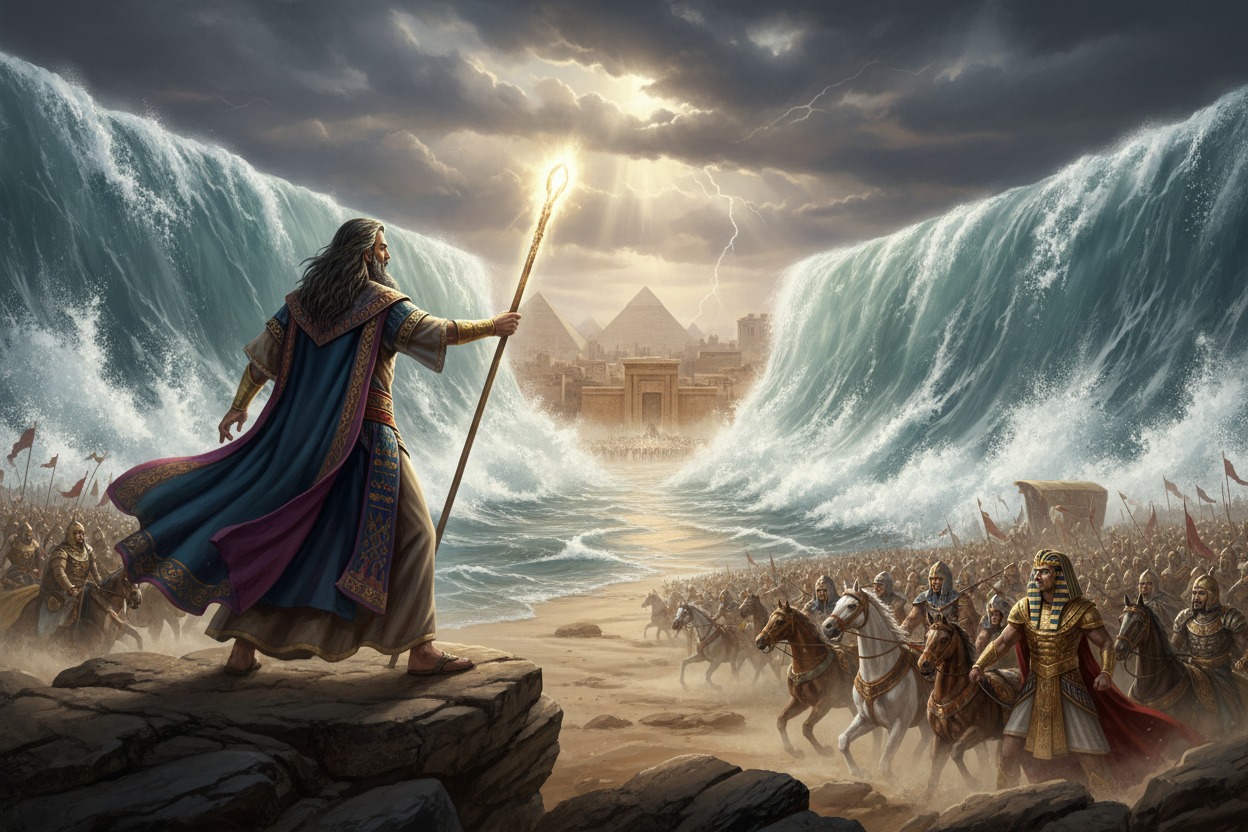
But the story was not over. Pharaoh would change his mind once again and pursue the Israelites, leading to another extraordinary event: the parting of the Red Sea.
Conclusion – Who is more powerful: Pharaoh or Yahweh?

The ten plagues demonstrated that Pharaoh’s power had limits, while Yahweh was fulfilling His plan to deliver His people.
Pharaoh had many opportunities to obey God’s command, but he continued to resist.
This extraordinary event teaches us several important lessons:
- God hears the cries of those who suffer.
- No human power can prevent His promises from being fulfilled.
- Pride and stubbornness can have serious consequences.
- God remains faithful to His promises, even when people must wait.
One verse that summarises the entire event is:
“Let My people go, that they may serve Me!” (Exodus 7:16)
This concludes our report on Moses, Pharaoh and the Ten Plagues that struck Egypt!
Biblical references: Exodus chapters 1–12.