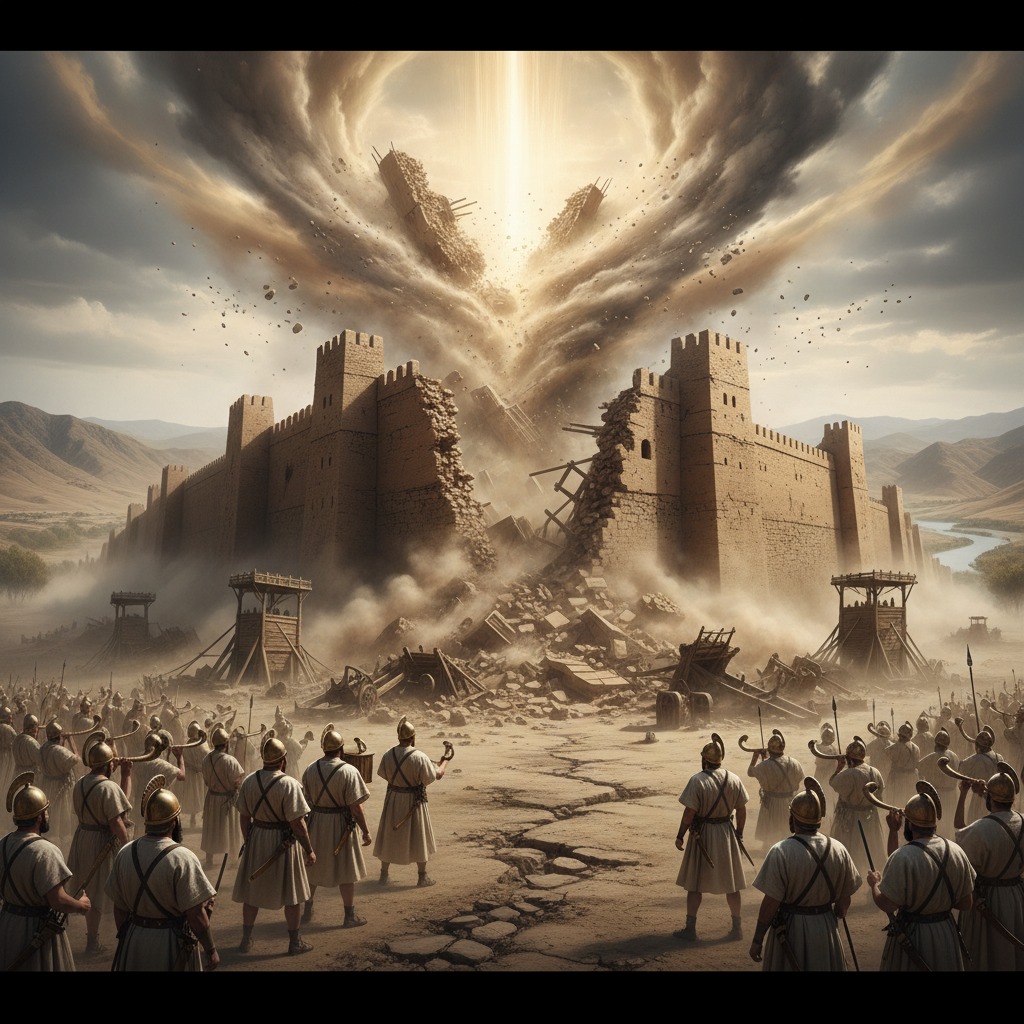
JERICHO, LAND OF CANAAN – One remarkable Old Testament event is Jericho’s fallen walls. The city was long seen as a strong fortress. It was conquered not by standard fighting, but by God’s command.
The narrative links Jericho’s fall to the Israelites’ faith and obedience. It underscores how divine power, not swords, secured the breach.
This event represents a significant moment in the history of the people of Israel. As part of THE FALL OF THE WALLS THAT CHANGED BIBLICAL HISTORY, it shows God’s faithfulness in Scripture.
Jericho – A Strategic and Well-Fortified City
Jericho was located near the Jordan Valley, in a strategically important region of Canaan, not far from the Jordan River.
The city held considerable geographical and military importance and was protected by strong defensive walls.
For the Israelites, Jericho represented their first major challenge in taking possession of the Promised Land.
According to the biblical account, the gates of the city were tightly shut because of fear of the Israelites, and its inhabitants were on high alert.
“Now Jericho was straitly shut up because of the children of Israel: none went out, and none came in.”
— Joshua 6:1 (KJV)
Preparations for the Conquest of Jericho
After the miraculous crossing of the Jordan River, under the leadership of Joshua, the people of Israel arrived near Jericho.
At that moment, God gave Joshua precise instructions concerning the conquest of the city. The strategy did not involve an immediate military assault or the destruction of the walls through conventional means.
The divine instructions were unusual: the Israelites were to march around the city once a day for six consecutive days.
Armed men would lead the procession, followed by seven priests carrying trumpets made from ram’s horns. The Ark of the Covenant would be carried in the procession, followed by the rest of the people.
“And ye shall compass the city, all ye men of war, and go round about the city once. Thus shalt thou do six days.”
— Joshua 6:3 (KJV)
Seven Days of Obedience and Discipline
For six days, the Israelites followed God’s instructions exactly.
Each day, the people marched around the city once while the priests blew their trumpets. The people were instructed not to shout or make any noise until the appointed moment.
On the seventh day, however, everything changed.
The Israelites marched around Jericho seven times, while the priests continued blowing their trumpets.
After the final circuit, Joshua gave the expected command.
“Shout; for the LORD hath given you the city.”
— Joshua 6:16 (KJV)
The Decisive Moment: The Walls of Jericho Collapse

At the sound of the trumpets and at Joshua’s command, the people raised a mighty shout.
According to the biblical account, the walls of Jericho collapsed, allowing the Israelites to enter the city.
The Bible does not attribute this victory to conventional military strategy, but to the intervention of God in response to the obedience of His people.
“So the people shouted when the priests blew with the trumpets: and it came to pass, when the people heard the sound of the trumpet, and the people shouted with a great shout, that the wall fell down flat.”
— Joshua 6:20 (KJV)
The event became one of the most well-known biblical accounts of faith, obedience, and the fulfilment of God’s promises.
Rahab and Her Family Are Spared
Before the conquest of Jericho, two Israelite spies had been welcomed into the home of Rahab, a woman living in the city.
She protected them and helped them escape from those searching for them. In return, she asked that her family be protected when the city was conquered.
As a sign of their agreement, Rahab was instructed to tie a scarlet cord in her window.
When the conquest took place, Joshua ordered that Rahab and her family be spared, honouring the promise made by the spies.
“But Rahab the harlot shall live, she and all that are with her in the house.”
— Joshua 6:17 (KJV)
This detail highlights the importance of faith and trust in the God of Israel within the biblical narrative.
Jericho After the Conquest
Following the fall of its walls, Jericho was conquered, and Joshua pronounced a curse upon anyone who would attempt to rebuild the city.
The biblical account presents the conquest as a decisive moment in the Israelites’ advance into Canaan.
Later, during the reign of King Ahab, the city was rebuilt by Hiel of Bethel. The biblical text records the fulfilment of Joshua’s earlier words.
“In his days did Hiel the Bethelite build Jericho.”
— 1 Kings 16:34 (KJV)
The Spiritual Significance of the Fall of Jericho
Beyond its historical dimension, the story of Jericho carries a powerful spiritual message.
The victory of the Israelites is presented as the result of obedience to God, patience, and faith in the fulfilment of His promises.
Jericho appeared to be an unconquerable fortress by the military standards of that time. Nevertheless, God instructed His people to follow His commands, even when the strategy seemed unusual.
For believers, this account remains a lesson about how obstacles that appear impossible to overcome are never greater than the power of God.
“By faith the walls of Jericho fell down, after they were compassed about seven days.”
— Hebrews 11:30 (KJV)
Conclusion – A Victory That Lives On in History
The fall of the walls of Jericho represents one of the most significant events in the Book of Joshua and in the biblical history of the people of Israel.
From the preparations for the conquest to the collapse of the walls, the account highlights the importance of obedience, faith, and trust in God.
Jericho was not simply a conquered city. It became a symbol of victory through faith and the fulfilment of divine promises.
The message of this biblical account remains relevant today: where human beings see walls that cannot be overcome, faith calls them to trust in God.
BIBLICAL SOURCES
- Joshua 2:1–24 – The spies sent to Jericho and Rahab.
- Joshua 3:14–17 – The Israelites cross the Jordan River.
- Joshua 5:13–15 – Joshua encounters the Commander of the LORD’s army.
- Joshua 6:1–5 – God’s instructions for the conquest of Jericho.
- Joshua 6:6–16 – The Israelites march around the city for seven days.
- Joshua 6:17–25 – The fall of the walls, the conquest of the city, and Rahab’s rescue.
- Joshua 6:26 – Joshua’s curse concerning the rebuilding of Jericho.
- 1 Kings 16:34 – The rebuilding of Jericho during the reign of Ahab.
- Hebrews 11:30–31 – The faith through which the walls of Jericho fell and the faith of Rahab.
Archaeological source: Jericho