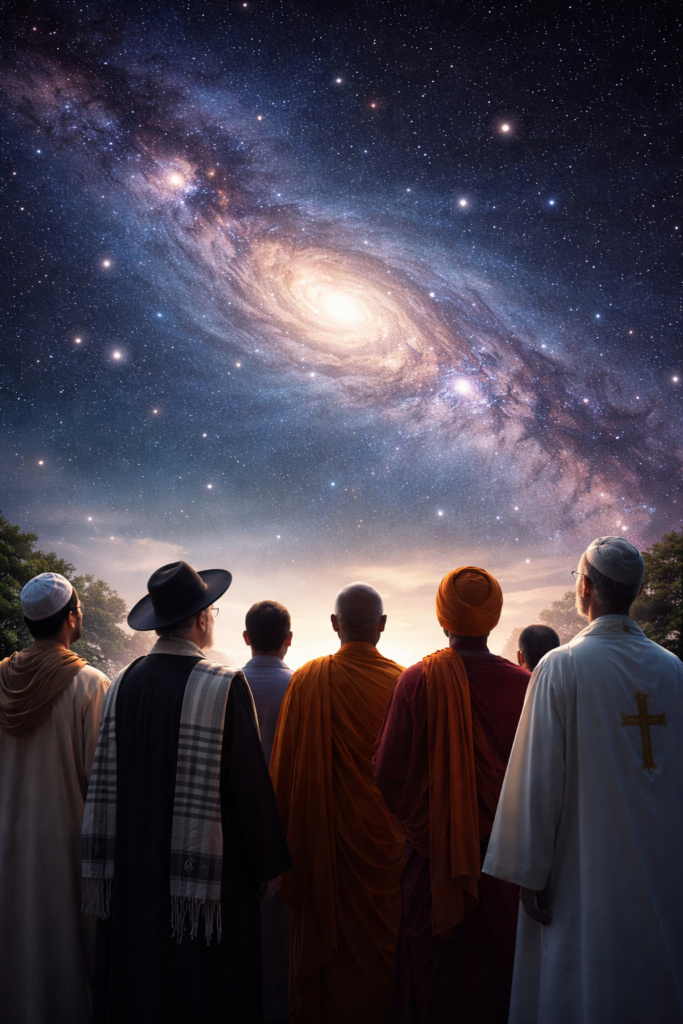
1. God – Creator of All Things
The Bible presents God as the Creator of the entire universe, not just of one group or religion.
“In the beginning God created the heavens and the earth.” (Genesis 1:1)
This statement is universal. It does not say that God created only one people or one faith, but all existence.
Also:
“The earth is the Lord’s, and everything in it, the world, and all who live in it.” (Psalm 24:1)
God is not limited by borders, cultures, or religious systems. He is the Lord of all creation.
2. God Does Not Dwell in Human-Made Limits
People tend to limit God to temples, traditions, or religions. The Bible contradicts this idea.
“The God who made the world and everything in it is the Lord of heaven and earth and does not live in temples built by human hands.” (Acts 17:24)
This shows that God is not “owned” by any religion or institution. He is above every system created by man.
3. God Is Near to Every Person
The Bible shows that God is not exclusive to a certain group, but is near to every person.
“He is not far from any one of us.” (Acts 17:27)
This closeness does not depend on belonging to a religion, but on a personal relationship with God.
4. All People Are Created by the Same God
All people, regardless of culture or religion, share the same origin.
“From one man he made all the nations, that they should inhabit the whole earth.” (Acts 17:26)
Therefore, there are not “different gods” for different peoples, but one God for all.
5. Groups of Believers as Guidance, Not the Final Goal
Groups of believers can have the role of guiding people toward God, but they are not God.
The Bible emphasizes that what matters is not the outward form, but a genuine relationship:
“God is spirit, and his worshipers must worship in the Spirit and in truth.” (John 4:24)
There are differences between beliefs and traditions. Some may lead closer to truth, others may deviate, but God remains unchanged.
6. Testing the Truth and Avoiding False Gods
The Bible warns that not every form of worship is directed toward the true God.
“For all the gods of the nations are idols, but the Lord made the heavens.” (Psalm 96:5)
Therefore, every Christian is called to examine carefully and with discernment:
“Test all things; hold fast what is good.” (1 Thessalonians 5:21)
A clear example is given by the believers in Berea:
“Now the Bereans were of more noble character… for they received the message with great eagerness and examined the Scriptures every day to see if what Paul said was true.” (Acts 17:11)
Truth must be sought and verified in the light of Scripture, not accepted blindly based on tradition or group identity.
7. God looks at the heart, not at a religious label
God does not judge people based on their religious affiliation, but on their heart.
“The Lord does not look at the things people look at. People look at the outward appearance, but the Lord looks at the heart.” (1 Samuel 16:7)
This shows that spiritual identity is not defined by a label, but by a genuine relationship with God.
8. One God for All Groups
The Bible clearly affirms the unity of God for all humanity:
“There is one God and Father of all, who is over all and through all and in all.” (Ephesians 4:6)
This statement excludes the idea that God belongs to a single group.
9. Conclusion
God does not belong to any cult or religion, but is the Creator and Lord of the entire universe.
He is not limited by human systems and cannot be claimed by a single faith.
A true relationship with God is personal, authentic, and based on truth.
The Bible reveals a universal, living God who is accessible to all people, not just to a limited group.