THE VICTORY WON THROUGH THE POWER OF GOD
Location: Israel, the Valley of Jezreel and the Spring of Harod
Biblical source: Judges 6–8
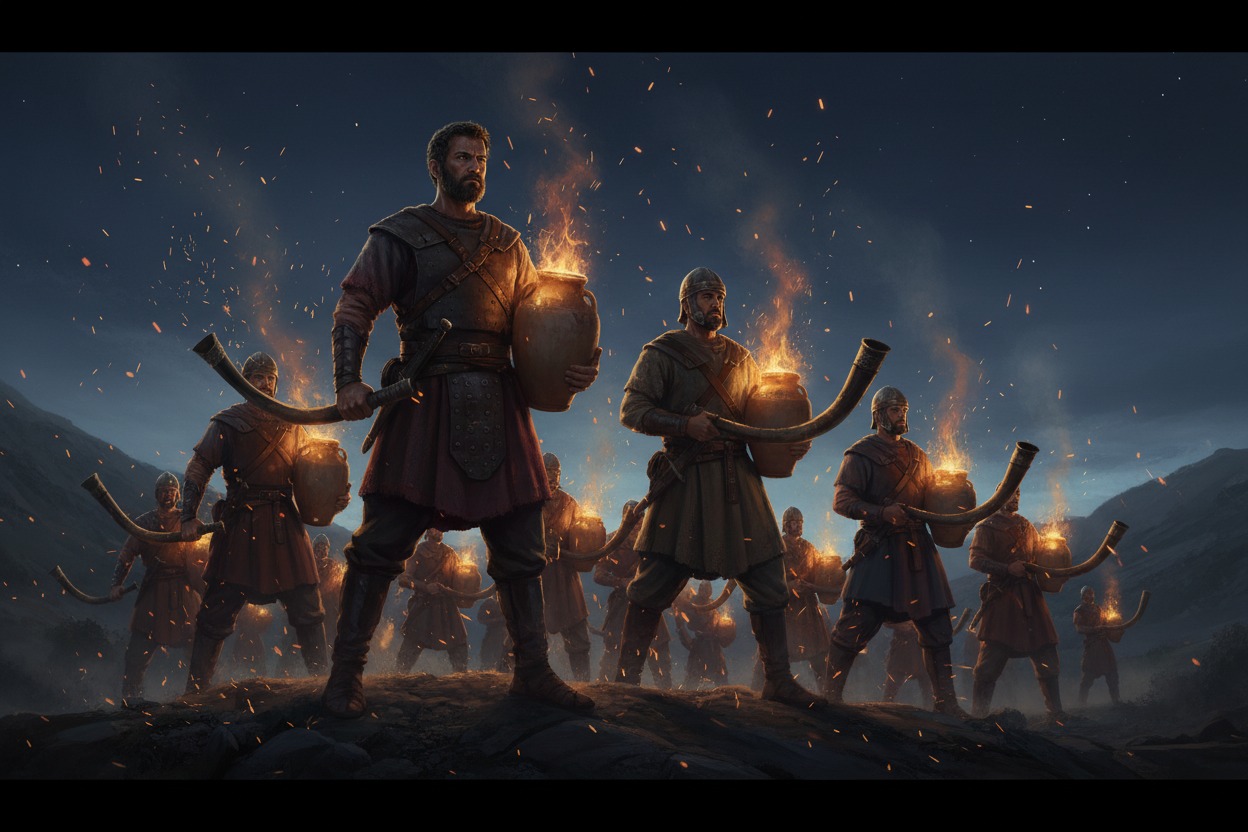
ISRAEL – An army of only 300 men has defeated a vast enemy force that threatened the people of Israel! Without relying on conventional weapons in battle, these men advanced against the Midianites carrying trumpets, empty jars, and burning torches.
Behind this extraordinary victory was a man named Gideon, an ordinary Israelite whom God chose to deliver His people from the oppression of a powerful enemy.
But who was Gideon? How were the 300 warriors selected? And how did such a small group defeat an enormous army?
Who was Gideon?
Gideon was the son of Joash, from the family of Abiezer, of the tribe of Manasseh. He lived during a very difficult period in Israel’s history.
The Israelites had turned away from God, and the Midianites had oppressed them for seven years. Whenever the Israelites planted their crops, their enemies would invade the land, destroy the harvest, and take their livestock.
Because of these attacks, the Israelites hid in caves and strongholds in the mountains.
One day, Gideon was threshing wheat in a winepress, trying to hide it from the Midianites. There, the Angel of the LORD appeared to him and delivered an unexpected message:
“The LORD is with you, you mighty man of valor!”
Gideon did not consider himself a mighty warrior. He wondered how God could be with Israel while the nation was suffering so greatly.
He also believed that he was too insignificant for such an important mission:
“My clan is the weakest in Manasseh, and I am the least in my father’s house.”
But God told him that He would use him to deliver Israel.
Gideon asked for a sign, and God confirmed His calling. Later, he also received the sign involving the fleece: first, the fleece was wet with dew while the ground remained dry; then the opposite happened.
Through these signs, Gideon received reassurance that God was with him.
The first mission: Destroying the altar of Baal
Before leading an army against the Midianites, Gideon received a mission within his own community.
God commanded him to tear down the altar of Baal belonging to his father and cut down the wooden image of Asherah beside it.
Gideon obeyed, but he was afraid of the people’s reaction. Therefore, he carried out the task at night with the help of ten servants.
The next morning, the people discovered the destroyed altar and demanded that Gideon be put to death.
However, Joash, Gideon’s father, answered them with a memorable question:
“Will you plead for Baal? Will you save him?”
Joash declared that if Baal really was a god, he should defend himself.
From that moment, Gideon also received the name Jerubbaal, because Joash had said that Baal should contend against him.
The enemy prepares to attack
The news that Gideon would lead the battle came at a critical moment.
The Midianites, Amalekites, and other eastern peoples gathered together, crossed the Jordan River, and camped in the Valley of Jezreel.
The Bible describes their numbers as being like a swarm of locusts. Their camels were so numerous that they seemed impossible to count.
Gideon was clothed with the Spirit of the LORD and blew a trumpet to call the Israelites to battle.
Men from several tribes responded:
- Manasseh;
- Asher;
- Zebulun;
- Naphtali.
In total, Gideon gathered 32,000 warriors.
But God had a surprising plan: the army had to become smaller!
Why were only 300 men selected?
Here begins one of the most unusual military selections in biblical history.
God told Gideon that he had too many men. If Israel won with such a large army, the people might believe that their own strength had brought them victory.
The first stage of the selection was simple: Gideon was instructed to tell anyone who was afraid to return home.
22,000 men left, while 10,000 remained.
But God told Gideon that there were still too many.

The second stage followed: the men were taken down to the water, where God would separate them.
Those who brought water to their mouths with their hands and lapped it were separated from those who knelt down to drink.
The result was astonishing:
THE SELECTION OF GIDEON’S ARMY
32,000
Initial warriors
22,000 leave – Those who are afraid
10,000
Remain after the first selection
300
Chosen for battle
Only 300 of the original 32,000 warriors remained.
The 300 were the men who brought the water to their mouths with their hands and lapped it, while the others knelt down to drink.
The biblical text does not say that these men were chosen because they were braver or better trained militarily. God selected them and told Gideon that through these 300 men He would deliver Israel.
Thus, an army of 32,000 became a small group of only 300!
God encourages Gideon and his servant
Despite God’s promise, Gideon still needed encouragement.
During the night, the LORD told him to go down to the Midianite camp with his servant Purah.
There, Gideon heard a soldier telling another about a dream. A loaf of barley bread had rolled through the Midianite camp, struck a tent, and overturned it.
Another soldier interpreted the dream:
“This is nothing else but the sword of Gideon the son of Joash, a man of Israel: into his hand God has delivered Midian and the whole camp.”
When Gideon heard these words, he worshiped God.
Now he was convinced that the LORD would give him victory.
The unusual battle plan: Trumpets, jars, and torches
Gideon divided his 300 men into three companies of 100 warriors each.
Their equipment was unusual:
- Trumpets;
- Empty clay jars;
- Burning torches hidden inside the jars.
The plan was simple, but it required coordination and courage.
Gideon instructed his men to watch him and do exactly as he did.
At the beginning of the middle watch, just after the guards had changed, the 300 approached the enemy camp.
At Gideon’s signal, they blew their trumpets, broke their jars, and raised their burning torches.
Then they shouted:
“The sword of the LORD and of Gideon!”
The scene was terrifying. Hundreds of lights suddenly appeared in the darkness. Trumpets sounded from every direction, while the noise of breaking jars echoed throughout the Midianite camp.
Panic spreads through the Midianite camp

The Midianites were overcome with panic!
The Bible says that the LORD caused the men in the camp to turn against one another with their swords.
The enemy soldiers began fighting among themselves and fled toward Beth Shittah, toward Zererah, as far as the border of Abel Meholah near Tabbath.
Gideon’s 300 men remained in position around the camp, blowing their trumpets and holding their torches.
Then men from Naphtali, Asher, and Manasseh were called to pursue the fleeing enemy. Gideon also sent messengers to Ephraim, whose men helped capture important Midianite leaders.
The victory was overwhelming!
Who were the leaders of the Midianites?
The battle continued even after the initial defeat of the Midianites.
Gideon pursued their two kings:
- Zebah;
- Zalmunna.
Eventually, Gideon captured and defeated them.
The Bible records that approximately 120,000 men who drew the sword had fallen during the campaign against the Midianites, while 15,000 remained with the fleeing army.
This victory brought an end to Midianite oppression over Israel.
What did Gideon and the 300 accomplish?
The victory of the 300 had important consequences for the people of Israel.
- They defeated a much larger Midianite army.
- They delivered Israel from Midianite oppression.
- They restored freedom and security to the people.
- They demonstrated that God can bring victory through a very small number of people.
- They helped restore peace throughout the land.
After the victory, the Israelites offered to make Gideon their ruler, together with his son and grandson.
But Gideon answered:
“I will not rule over you, nor shall my son rule over you; the LORD shall rule over you.”
Gideon judged Israel for 40 years, and the land had peace throughout his lifetime.
Conclusion of the report
The story of Gideon and the 300 warriors is one of the most remarkable biblical accounts of faith, obedience, and God’s intervention.
Gideon was not a famous warrior. At first, he considered himself insignificant and doubted that he could lead Israel. Yet God chose him, encouraged him, and transformed him into a leader who delivered his people.
The 300 did not win through numerical superiority or powerful weapons. They followed God’s plan, and their victory demonstrated that true strength does not depend on the number of people, but on God.
Spiritual lessons from the event
- God can use ordinary people to accomplish extraordinary things. Gideon considered himself too insignificant for the mission.
- Faith can overcome fear. Gideon had doubts, but he learned to trust God.
- Numbers do not determine victory. The 300 were enough for God’s plan.
- Obedience is more important than human strength. The warriors followed the instructions they had received.
- The glory belongs to God. The reduction of the army prevented the people from boasting about their own strength.
KEY VERSE OF THE REPORT
“The people who are with you are too many.”
(Judges 7:2 – God’s explanation for reducing the army)
THE CENTRAL MESSAGE
With God, 300 can defeat an entire army!
FINAL: From a man who considered himself insignificant, God raised up a leader. From an army of 32,000, He chose only 300. And with trumpets, jars, and torches, these men sent a vast army fleeing. Gideon’s victory remains a powerful testimony that when God is with His people, the impossible can become possible!