
THE MAN WHO CHALLENGED A KING AND PAID THE ULTIMATE PRICE
He emerged from the wilderness, confronted religious authorities, publicly challenged a ruler, and became one of the most remarkable figures of first-century Judea. His name was John the Baptist. His story is one of public controversy, political tension, and a dramatic execution that has echoed through history.
A CHILD BORN AGAINST ALL EXPECTATIONS
According to the Gospel of Luke, John The Baptist story began in the family of an elderly Jewish priest.
Additionally, Zechariah was a priest, and his wife Elizabeth.
The couple had no children, and Elizabeth was described as unable to conceive. Their lives changed when Zechariah reportedly received a message from an angel announcing the birth of a son.
The child was to be named John.
The Gospel records the announcement:
“Your wife Elizabeth will bear you a son, and you are to call him John.” (Luke 1:13)
According to the biblical account, John’s birth was considered extraordinary, and his future role was described as preparing the people for the arrival of a significant historical and a faith figure.
THE PREACHER WHO ATTRACTED CROWDS
Years later, John appeared in the wilderness of Judea, attracting attention through his unusual lifestyle and uncompromising public speeches.
The biblical descriptions portray him wearing clothing made of camel’s hair, with a leather belt around his waist. His diet consisted of locusts and wild honey.
His message was direct:
“Repent, for the kingdom of heaven has come near.” (Matthew 3:2)
People reportedly travelled from Jerusalem, Judea, and the surrounding Jordan region to hear him speak.
John baptised people in the Jordan River, a practice associated with repentance and personal purification.
His growing popularity made him an influential public preacher in the region.
HE DID NOT SPARE THE RELIGIOUS AUTHORITIES
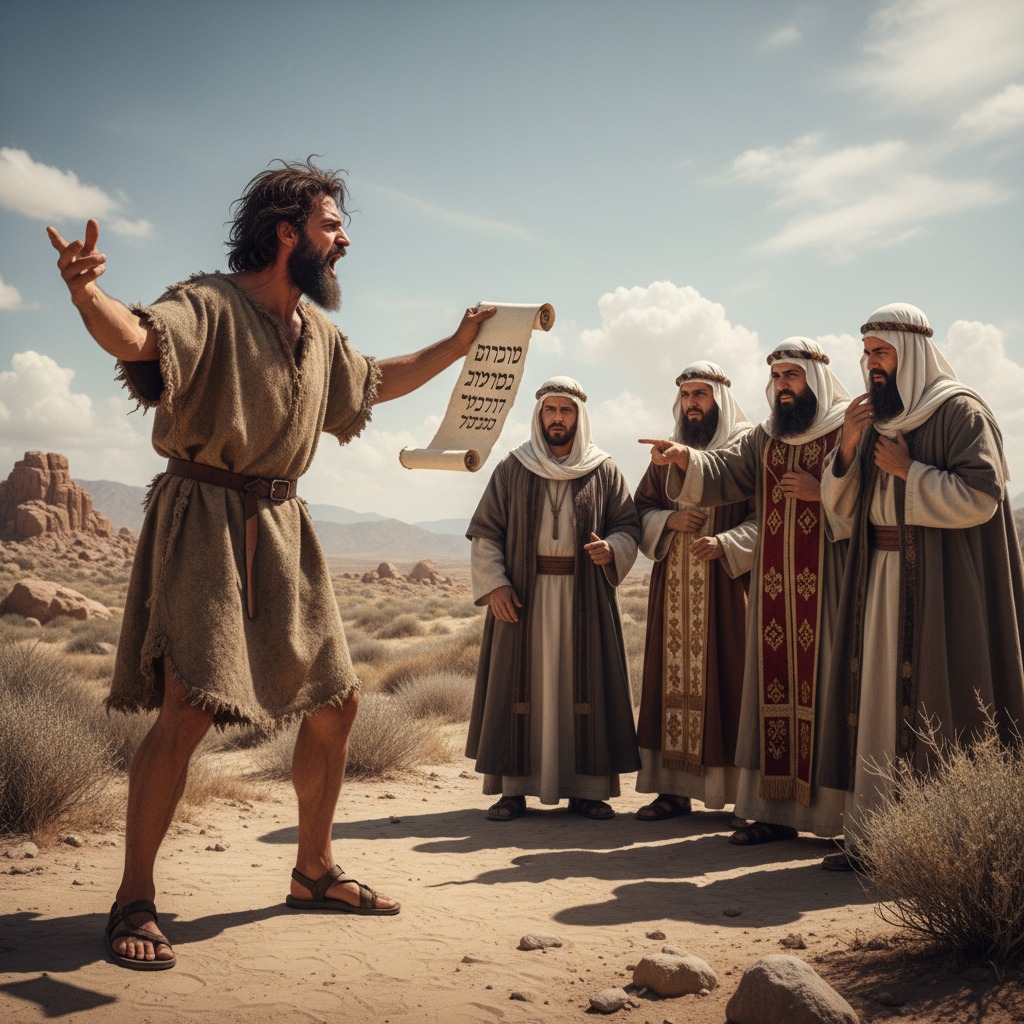
John The Baptist’s criticism was not limited to ordinary people.
According to the Gospel accounts, he openly challenged the Pharisees and Sadducees, two influential Jewish religious groups of the period.
He questioned the sincerity of those who came to be baptised and insisted that their actions should reflect genuine change.
“Produce fruit in keeping with repentance.” (Matthew 3:8)
His message challenged religious appearances, inherited status, and claims of moral authority.
John was becoming a figure who attracted both public attention and controversy.
THE ENCOUNTER WITH JESUS OF NAZARETH
One of the most significant episodes in John’s story concerns his encounter with Jesus.
According to the Gospels, Jesus came to the Jordan River to be baptised by John.
Although John initially hesitated, he eventually performed the baptism.
The Gospel of Matthew describes the event as involving a vision of the heavens opening and a voice identifying Jesus as God’s beloved Son.
“This is my Son, whom I love; with him I am well pleased.” (Matthew 3:17)
The Gospel of John also records a declaration attributed to John the Baptist when he saw Jesus:
“Look, the Lamb of God, who takes away the sin of the world!” (John 1:29)
These accounts established John as an important figure in the narrative surrounding the early public activity of Jesus.
A MAN WHO DID NOT SEEK THE SPOTLIGHT
As Jesus attracted increasing attention, John continued to acknowledge the distinction between his own role and that of Jesus.
One of the most frequently quoted statements attributed to him appears in the Gospel of John:
“He must become greater; I must become less.” (John 3:30)
This statement reflects John’s position as described in the Gospel narrative: his public mission was not intended to establish a competing movement centred on himself.
THE CONFRONTATION WITH HEROD ANTIPAS
The most dramatic chapter of John’s life involved a direct confrontation with political authority.
Herod Antipas, ruler of Galilee and Perea, became the subject of John’s public criticism because of his relationship with Herodias, who had previously been married to his brother Philip.
John openly condemned the relationship.
“It is not lawful for you to have her.” (Matthew 14:4)
According to the biblical accounts, Herodias became hostile toward John, while Herod eventually ordered his imprisonment.
This confrontation reveals an important aspect of John’s historical portrayal: he was not merely a preacher addressing private morality. He was a public figure willing to criticise the personal conduct of a powerful ruler.
The Execution That Shocked His Followers
John’s imprisonment ended in a dramatic and violent episode.
According to the Gospels of Matthew and Mark, Herod organised a birthday celebration attended by influential guests.
During the event, the daughter of Herodias performed a dance that pleased Herod.
He promised to grant her a request.
After consulting her mother, she asked for the head of John the Baptist on a platter.
Herod was reportedly distressed by the request, but because of his promises and the presence of his guests, he ordered the execution.
The Gospel of Matthew describes the final moments:
“His head was brought in on a platter and given to the girl, who carried it to her mother.” (Matthew 14:11)
John’s disciples later collected his body and buried it.
His execution became one of the most disturbing episodes associated with the court of Herod Antipas.
JESUS’ REMARKABLE ASSESSMENT OF JOHN
The Gospel of Matthew records a remarkable statement attributed to Jesus concerning John.
“Among those born of women there has not risen anyone greater than John the Baptist.” (Matthew 11:11)
This passage demonstrates the importance assigned to John within the Gospel narratives.
He was portrayed not simply as a preacher, but as a major transitional figure between the prophetic traditions of ancient Israel and the emergence of the Jesus movement.
THE HISTORICAL LEGACY OF JOHN THE BAPTIST
John the Baptist remains one of the most recognisable personalities of first-century Judea.
His story combines several elements that made him historically significant:
- His unusual lifestyle and public preaching in the wilderness.
- His baptism movement along the Jordan River.
- His criticism of established religious authorities.
- His connection with the early public activity of Jesus of Nazareth.
- His confrontation with Herod Antipas.
- His imprisonment and execution.
His influence extended beyond the circumstances of his death. The Gospel accounts describe his followers as an identifiable group, and references to his baptism and teachings also appear in the Acts of the Apostles.
John’s story offers a striking portrait of a man operating in a politically sensitive and socially complex period of ancient Judea.
Whether examined through the lens of biblical literature, ancient history, or the development of early Christianity, John the Baptist remains a figure whose life and death deserve serious historical attention.
His voice may have been silenced in prison, but his name survived in some of the most influential texts of Western history.
BIBLICAL SOURCES AND REFERENCES
Prophetic passages associated with John
- Isaiah 40:3 – The voice calling in the wilderness.
- Malachi 3:1 – The messenger preparing the way.
- Malachi 4:5–6 – The prophecy concerning the coming of Elijah.
The life, activity, and death of John the Baptist
- Matthew 3:1–12 – John’s preaching and baptism.
- Matthew 11:2–19 – John’s questions and Jesus’ assessment of him.
- Matthew 14:1–12 – John’s imprisonment and execution.
- Matthew 17:10–13 – The connection between John and Elijah.
- Mark 1:1–8 – John prepares the way.
- Mark 6:14–29 – The circumstances of John’s execution.
- Luke 1:5–25 – The announcement of John’s birth.
- Luke 1:39–45 – Mary visits Elizabeth.
- Luke 1:57–80 – John’s birth and Zechariah’s prophecy.
- Luke 3:1–20 – John’s preaching and baptism.
- Luke 7:18–35 – John’s questions and Jesus’ testimony.
- John 1:6–8 – John as a witness to the light.
- John 1:15 – John’s testimony concerning Jesus.
- John 1:19–34 – John’s public testimony and identification of Jesus.
- John 1:35–37 – John’s disciples follow Jesus.
- John 3:22–36 – John’s final testimony concerning his role.
- Acts 1:5 – Reference to John’s baptism.
- Acts 10:37 – John’s baptism ministry.
- Acts 11:16 – Reference to the baptism of John.
- Acts 13:24–25 – Paul’s account of John’s ministry.
- Acts 18:24–25 – Apollos and the baptism of John.
- Acts 19:1–7 – Paul’s discussion of John’s baptism in Ephesus.