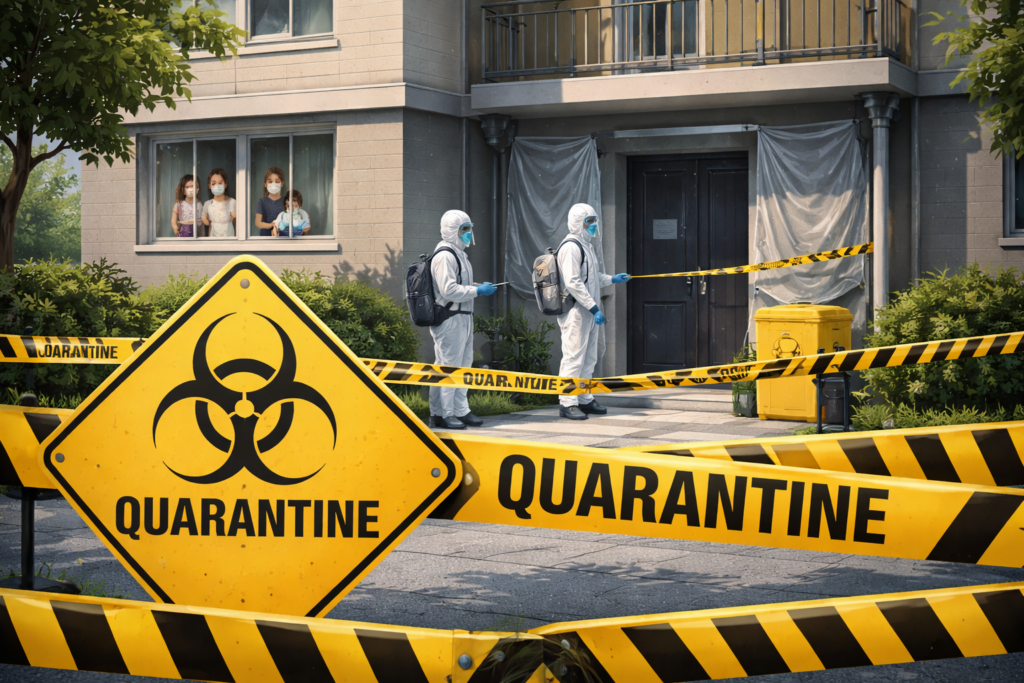
Quarantine of Contagious Diseases
1. Biblical texts
Leviticus 13:45–46
A person with a contagious disease had to remain separated from the community; their dwelling was outside the camp.
Leviticus 13:4–5
The suspected individual was isolated for seven days, then re-examined.
Leviticus 13:6
If the disease did not progress, the person was declared clean and reintegrated.
Leviticus 14:8
After healing, washing of clothes and body was required before returning.
2. Structure of the medical procedure
The text outlines a complete protocol:
- Clinical observation
identification of visible symptoms - Preventive isolation
temporary separation of the suspected person - Periodic reevaluation
examination after the incubation period - Confirmation or rejection
empirical differential diagnosis - Decontamination
washing body and objects - Controlled reintegration
return only after confirmed recovery
This corresponds to a modern epidemiological procedure.
3. What modern medicine says
Control of infectious diseases includes the same stages:
| Medical step | Modern practice |
|---|---|
| screening | clinical evaluation |
| isolation | quarantine |
| incubation period | observation |
| diagnosis | confirmation |
| decontamination | hygiene and sterilization |
| discharge | safe return |
Quarantine is one of the most effective epidemic-prevention methods.
4. When quarantine appeared in history
| Period | Event |
|---|---|
| Antiquity | regulations in Leviticus |
| 1347 | Venice introduces 40-day quarantine (plague) |
| 19th century | germ theory (Pasteur, Koch) |
| Modern medicine | scientific epidemiology |
The Bible describes the system more than 3000 years before microbiology.
5. Medical interpretation
The disease described (“tzaraat”) was not only modern leprosy, but a group of contagious skin disorders.
The focus is not treatment, but prevention of transmission.
Central principle:
a potentially infected person must be separated until clarified.
This is exactly the principle of modern public health.
Conclusion
The laws in Leviticus form a coherent infection-control system:
observation
isolation
monitoring
hygiene
reintegration
The model is compatible with current epidemiology and reflects a remarkable preventive approach for the ancient world.
Interpretation depends on perspective:
christian — divine protection of the community
historical — early sanitary code
medical — primitive form of public health
Surse medicale pentru informațiile prezentate
Carantina bolilor contagioase / epidemiologie
- CDC — Principles of Epidemiology in Public Health Practice
https://www.cdc.gov/csels/dsepd/ss1978/index.html - World Health Organization — Infection prevention and control
https://www.who.int/health-topics/infection-prevention-and-control - History of Quarantine — Centers for Disease Control and Prevention
https://www.cdc.gov/quarantine/historyquarantine.html - Heymann, D. — Control of Communicable Diseases Manual (manual standard epidemiologic)
Leave a Reply