Introduction
Iron is one of the most important elements for life on Earth. Although it is commonly known as a metal used in construction and industry, iron has a crucial role in the human body: the transport of oxygen in the blood. Without iron, life as we know it could not exist.
Remarkably, the chemical structure of iron allows it to perform an extremely precise function within the body. This function is carried out through hemoglobin, the molecule in red blood cells that transports oxygen from the lungs to every cell in the body.
Many believers see this complexity and precision as evidence of the wisdom and order established by God in creation.
“For the invisible things of him from the creation of the world are clearly seen, being understood by the things that are made.” — Romans 1:20 (KJV)
Iron – An Essential Element of Life
Iron (Fe) is element number 26 in the periodic table. It is one of the most abundant metals in the Earth’s crust and has chemical properties that make it ideal for biological processes.
Important characteristics of iron include:
- the ability to bind and release oxygen
- chemical stability within biological structures
- the ability to participate in oxidation–reduction reactions
These properties allow iron to become the central component of hemoglobin.
Hemoglobin – The Mechanism that Transports Life
Human blood contains billions of red blood cells. Each of them carries millions of hemoglobin molecules.
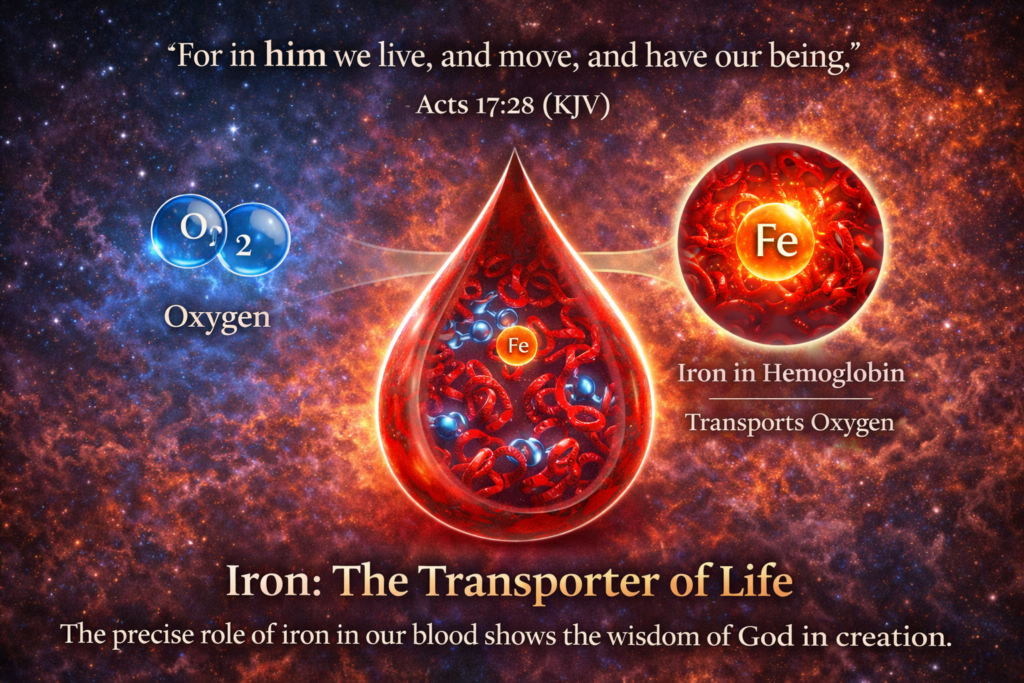
Hemoglobin is a complex protein that contains an atom of iron at its center. This iron atom allows hemoglobin to bind oxygen in the lungs and transport it through the bloodstream to the body’s tissues.
The process works in the following way:
- In the lungs, the iron in hemoglobin binds to oxygen.
- The blood carries the oxygen through the circulatory system.
- In the tissues, oxygen is released so that cells can produce energy.
This mechanism is extremely precise. If iron did not possess exactly the right chemical properties, oxygen could not be transported efficiently through the body.
The Amount of Iron in the Human Body
The human body contains only about 3–4 grams of iron, yet this small amount is absolutely vital.
Most of the body’s iron is found in:
- hemoglobin (in red blood cells)
- myoglobin (in muscles)
- enzymes involved in metabolism
Without iron, the body develops anemia, a condition in which the blood cannot carry enough oxygen.
This demonstrates how critical this element is for life.
The Cosmic Origin of Iron
A fascinating discovery of astronomy is that iron is not easily formed in ordinary processes. It is created inside massive stars during nuclear reactions and during stellar explosions called supernovae.
This means that the iron atoms in our blood were once formed in the cores of ancient stars.
Thus, the elements that sustain life on Earth have a deep origin within the structure of the universe.
The Bible declares that God is the Creator of the entire universe.
“In the beginning God created the heaven and the earth.” — Genesis 1:1 (KJV)
Iron and the Precision of Creation
The properties of iron are remarkably suited to the role it performs in the human body.
If iron bound oxygen too weakly, oxygen could not be transported effectively.
If it bound oxygen too strongly, oxygen would never be released into the tissues.
Iron has exactly the chemical properties required to bind oxygen in the lungs and release it where it is needed.
This precision has led many scientists and philosophers to reflect on the remarkable order present in nature.
The Bible says:
“Who being the brightness of his glory… upholding all things by the word of his power.” — Hebrews 1:3 (KJV)
A Spiritual Lesson
The iron in our blood transports oxygen that allows our cells to produce energy and sustain life. Without this process, life would quickly cease.
This reminds us that life depends on extremely complex and precise systems.
For many believers, such complexity reflects the wisdom of God in creation.
“For in him we live, and move, and have our being.” — Acts 17:28 (KJV)
Conclusion
Iron is an essential element for life because it enables the transport of oxygen in the body through hemoglobin. Without this process, cells would not be able to produce the energy required for life.
The precise chemical properties of iron, its role in biology, and its cosmic origin demonstrate the remarkable complexity and harmony present in nature.
Such examples in the natural world point to the wisdom and order of the Creator.
“Know ye that the LORD he is God: it is he that hath made us, and not we ourselves.” — Psalm 100:3 (KJV)
Scientific Sources
- Nelson, D. L., & Cox, M. M. — Lehninger Principles of Biochemistry
- Brown, T. L., LeMay, H. E., Bursten, B. E. — Chemistry: The Central Science
- Petrucci, R. H. — General Chemistry: Principles and Modern Applications
- NASA — Stellar Nucleosynthesis and the Origin of Elements
- National Institutes of Health (NIH) — Iron in Human Biology
0 responses to “Iron”