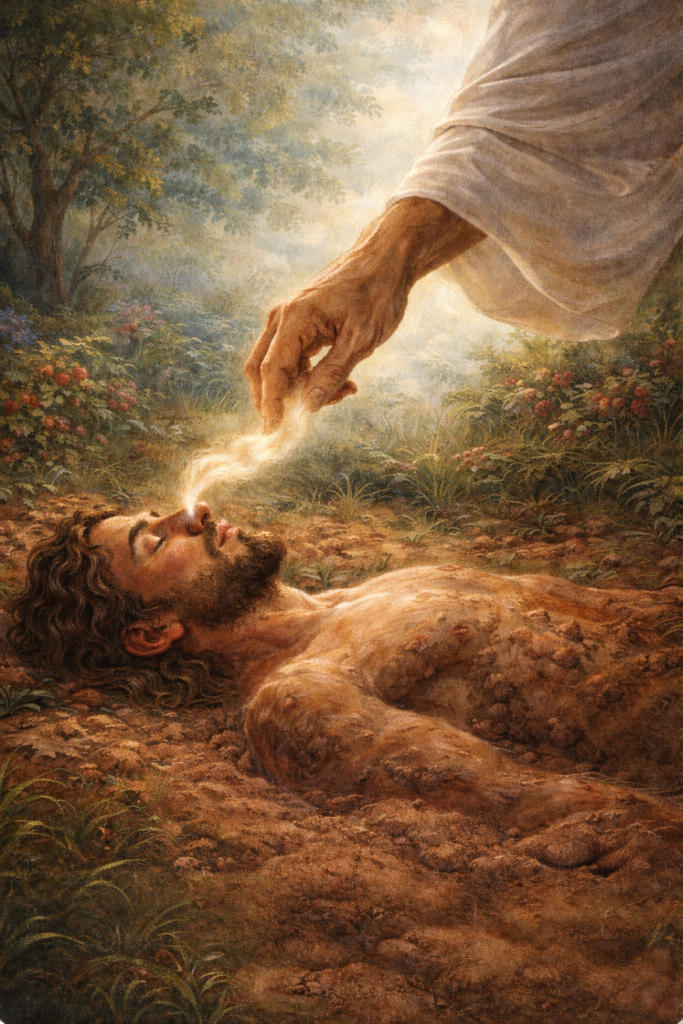
IIt is commonly said that a human being “has” an immortal soul separate from the body. However, the Bible presents humanity differently: man does not receive a soul as an object — he becomes a living soul through the union of the body with the breath of life given by God.
1. The Biblical Definition of Man – Genesis 2:7 (KJV)
“And the LORD God formed man of the dust of the ground, and breathed into his nostrils the breath of life; and man became a living soul.”
Important Observation
The text does not say man was given a soul, but that man became a living soul.
Biblical formula:
BODY (dust) + BREATH OF LIFE = LIVING SOUL (living being)
In Scripture, soul means the whole person, not a separate immaterial component.
2. The Same Expression Used for Animals – Genesis 1:20,24 (KJV)
Animals are also called living souls.
Conclusion: “living soul” means a living creature, not an immortal spiritual entity.
3. At Death the Soul Does Not Depart Consciously – Ecclesiastes 12:7 (KJV)
“Then shall the dust return to the earth as it was: and the spirit shall return unto God who gave it.”
What Happens at Death
The creation process reverses:
LIVING SOUL – BREATH = DEAD BODY
The spirit is not a conscious person but the life‑breath given by God to all creatures.
4. The Dead Are Not Conscious – Ecclesiastes 9:5 (KJV)
“For the living know that they shall die: but the dead know not any thing.”
If the soul lived independently, the text could not say this.
5. The Soul Can Die – Ezekiel 18:4 (KJV)
“The soul that sinneth, it shall die.”
An immortal soul cannot die. Scripture identifies the soul with the person — and the person dies.
6. Life Is in the Blood – Deuteronomy 12:23 (KJV)
“Only be sure that thou eat not the blood: for the blood is the life; and thou mayest not eat the life with the flesh.”
Meaning
Life is connected to the living organism, not a separable conscious entity existing apart from the body.
7. The Soul Experiences Physical Needs – Psalm 107:9 (KJV)
“For he satisfieth the longing soul, and filleth the hungry soul with goodness.”
The soul is the person who feels hunger and thirst — not a separate immaterial being.
8. Return to Dust – Genesis 3:19 (KJV)
“In the sweat of thy face shalt thou eat bread, till thou return unto the ground; for out of it wast thou taken: for dust thou art, and unto dust shalt thou return.”
Death is a return to the pre‑creation state — not the release of a conscious soul.
9. The Hope Is the Resurrection – 1 Corinthians 15:4-5 (KJV)
“And that he was buried, and that he rose again the third day according to the scriptures: And that he was seen of Cephas, then of the twelve.”
Christian faith is centered on resurrection, not the natural survival of the soul after death.
Conclusion
The Bible presents man as an indivisible unity. Man is not a body that contains a soul; he is a living soul — a living being resulting from the union of the body with the breath of life given by God.
Death is the opposite of creation, and the believer’s hope is not the natural immortality of the soul but the resurrection promised by God.
Leave a Reply