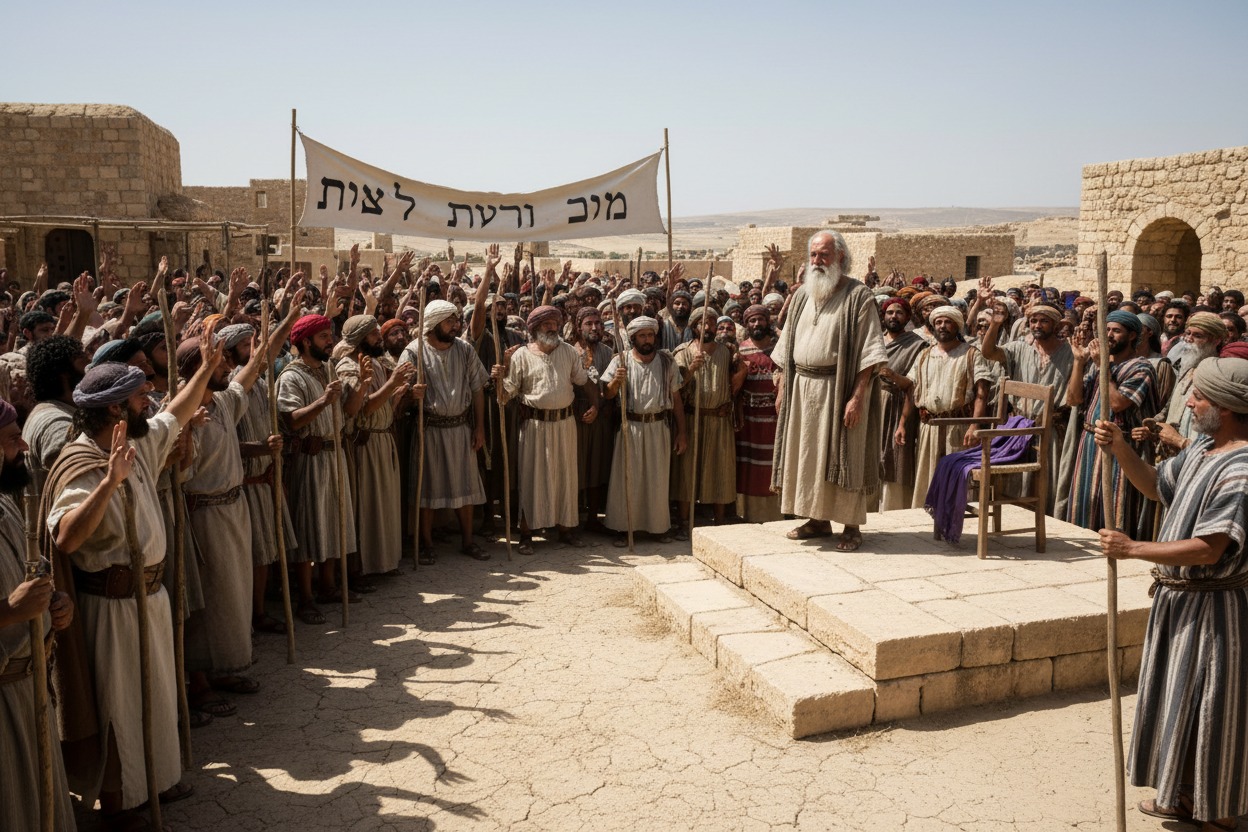
Israel’s Desire for a Human Ruler
A nation wanted change. Its people were no longer satisfied with the way they were governed. They wanted a king, a central authority, a visible leader, and someone who could lead their armies into battle.
This was not a modern political movement. It was a turning point in the history of ancient Israel, recorded thousands of years ago in the biblical account.
At the center of the story were Samuel, the prophet and judge, and Saul, the man who would become Israel’s first king.
But what kind of leadership existed before Saul? Why did the people demand a king? And what were the consequences of their decision?
Saul
Previously, the Lord was Israel’s king before Saul.
To understand the significance of the people’s demand, we first need to look at how Israel was governed before the monarchy.
Before Saul, Israel had no permanent human king and no established royal dynasty. According to the biblical account, the LORD Himself was regarded as the nation’s supreme ruler.
This system is commonly described as a theocracy, meaning that ultimate authority was attributed to God.
After the Israelites left Egypt, Moses became their principal human leader. He guided them through the wilderness, communicated the laws, and helped organize their community.
After Moses’ death, Joshua took over and led the people during their settlement in Canaan.
Following Joshua’s generation came the period of the Judges. During this era, Israel had no permanent monarch. Instead, different leaders emerged at different times to settle disputes, provide guidance, and deliver the people from military threats.
The biblical text expresses this understanding of divine authority:
“For the LORD is our judge, the LORD is our lawgiver, the LORD is our king; he will save us.”
Another passage declares:
“The LORD shall reign for ever and ever.”
Deuteronomy also describes the LORD as King over Israel:
“And he was king in Jeshurun, when the heads of the people and the tribes of Israel were gathered together.”
In other words, human leaders served at different times, but the LORD was understood to hold the highest authority.
One particularly revealing episode appears in the story of Gideon. When the Israelites offered to make him their ruler and establish a hereditary dynasty, he refused:
“I will not rule over you, neither shall my son rule over you: the LORD shall rule over you.”
This statement captures the leadership model that existed before the establishment of the monarchy.
A LEADERSHIP CRISIS: THE PEOPLE HAD LOST CONFIDENCE
As Samuel grew older, he appointed his sons, Joel and Abijah, as judges over Israel in Beersheba.
However, they did not follow their father’s example. According to the biblical account, they pursued personal gain, accepted bribes, and perverted justice.
The situation created growing dissatisfaction among Israel’s elders.
Eventually, they approached Samuel with a demand that would change the nation’s political future:
“Behold, thou art old, and thy sons walk not in thy ways: now make us a king to judge us like all the nations.”
This was not simply a request to replace two dishonest officials. The elders wanted an entirely different system of government.
They wanted a monarchy.
“WE WANT A KING LIKE OTHER NATIONS!”
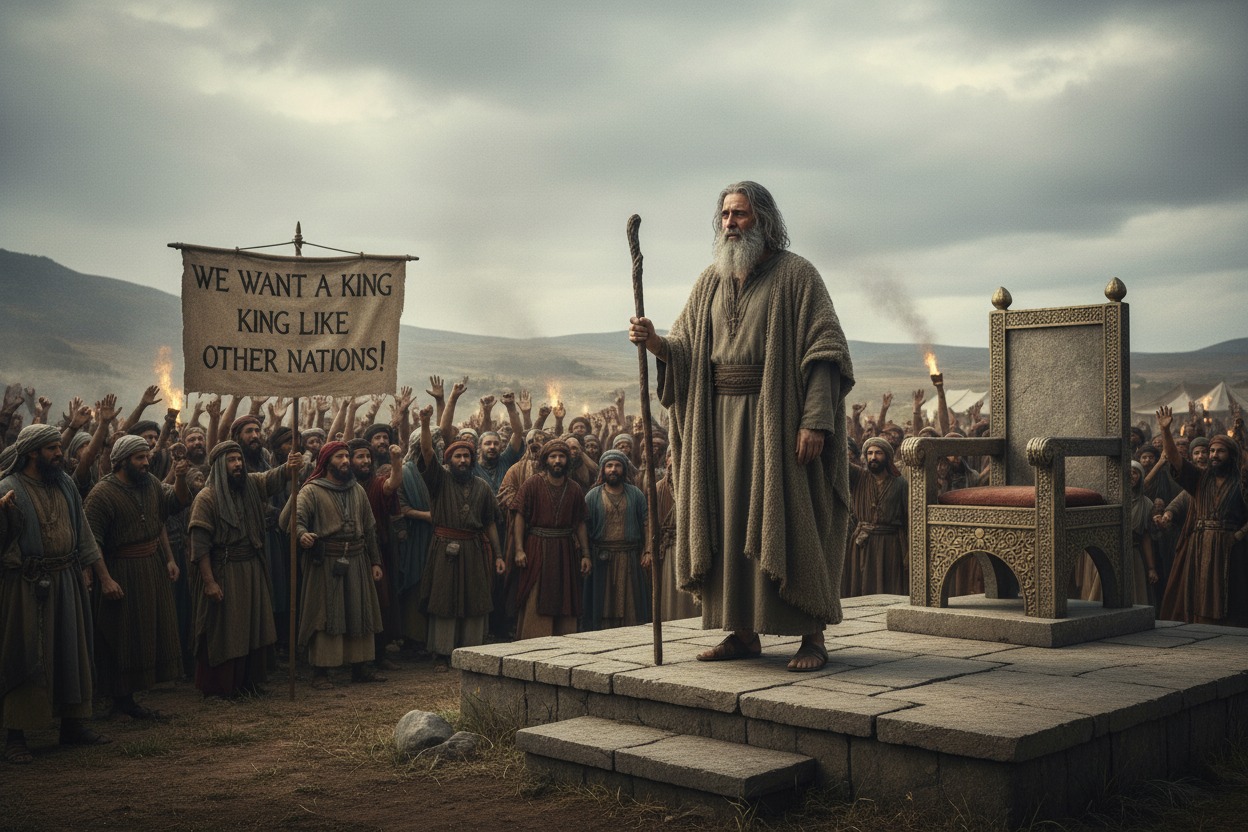
The elders were looking beyond Israel’s traditional leadership structure. They wanted a political system similar to those already established among neighboring nations.
A king meant more than a royal title. In the ancient Near East, monarchy generally involved:
- Centralized political authority.
- A permanent military command.
- Greater administrative coordination.
- A visible national representative.
- A royal institution with continuity.
Israel’s leaders wanted the same kind of political structure they saw elsewhere.
They wanted a ruler who could make decisions, command the army, and represent the nation.
SAMUEL’S WARNING: A KING WOULD COME AT A COST
Samuel’s warning shows that Saul would bring a king, and that would come at a cost.
Samuel was deeply troubled by the request.
He understood that establishing a monarchy would bring significant changes to the lives of ordinary people.
He warned the Israelites that a king would recruit their sons into military service, appoint officials, take their land and agricultural produce, and impose demands on the population.
His warning included these words:
“He will take your sons, and appoint them for himself, for his chariots, and to be his horsemen.”
And:
“And he will take your fields, and your vineyards, and your oliveyards, even the best of them, and give them to his servants.”
The message was straightforward: a monarchy would not only provide leadership and military organization. It would also concentrate power and resources in the hands of the king.
The people wanted security and national unity, but Samuel wanted them to understand what they might have to surrender in return.
THE LORD’S RESPONSE: “THEY HAVE REJECTED ME AS THEIR KING”
One of the most significant moments in the entire account comes when God responds to Samuel.
“They have not rejected thee, but they have rejected me, that I should not reign over them.”
This statement reveals the deeper meaning of the people’s demand.
According to the biblical narrative, Israel was not simply asking for a new human leader. The people were moving away from a system in which the LORD was recognized as their supreme King and asking for a human monarch instead.
The transition represented a fundamental change in the nation’s political and faith identity.
THE PEOPLE REFUSE TO BACK DOWN
Despite Samuel’s warnings, the elders remained determined.
Their response made their expectations perfectly clear:
“Nay; but we will have a king over us; that we also may be like all the nations; and that our king may judge us, and go out before us, and fight our battles.”
They wanted a leader who could settle disputes, command their armies, and take responsibility for national defense.
Their decision was no longer simply about dissatisfaction with Samuel’s sons. It was about redefining how the entire nation would be governed.
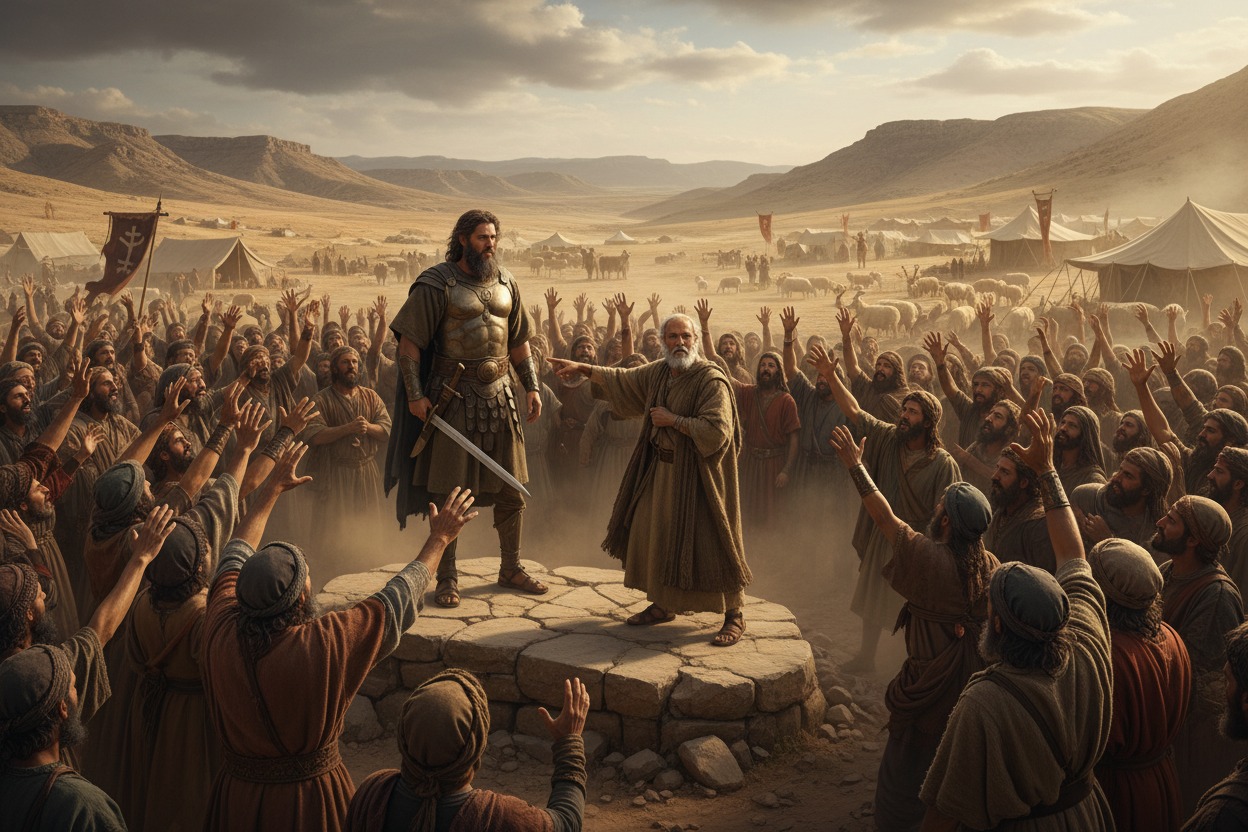
SAUL: THE MAN CHOSEN TO BECOME KING
Saul was the son of Kish, from the tribe of Benjamin.
The biblical account describes him as an impressive young man, distinguished by his height and physical appearance.
“From his shoulders and upward he was higher than any of the people.”
Interestingly, Saul’s story does not begin with a political campaign or an ambition to become king.
He is introduced while searching for his father’s lost donkeys.
During this journey, he meets Samuel, and their encounter changes the course of his life.
Samuel anoints Saul with oil and informs him that he will become Israel’s leader.
THE ANOINTING OF SAUL: THE MONARCHY BEGINS
Samuel takes a flask of oil and pours it over Saul’s head, marking his selection as Israel’s future king.
“Is it not because the LORD hath anointed thee to be captain over his inheritance?”
Saul is later presented before the people at Mizpah.
Not everyone welcomes the decision. Some question his ability to lead, while others refuse to accept him.
The biblical account records:
“But the children of Belial said, How shall this man save us? And they despised him.”
From the beginning, the new monarchy faced a familiar political challenge: winning public confidence and establishing legitimacy.
SAUL’S FIRST MAJOR TEST: PROVING HIS LEADERSHIP
Saul soon faces an opportunity to demonstrate his ability as a military leader.
Nahash, the Ammonite king, threatens the inhabitants of Jabesh-gilead. The people of the city appeal for help.
Saul responds by mobilizing the Israelites and organizing an attack against the Ammonites.
The campaign ends in victory.
This success strengthens Saul’s position and gives the people a practical reason to recognize his leadership.
At Gilgal, his kingship is formally reaffirmed:
“And all the people went to Gilgal; and there they made Saul king before the LORD in Gilgal.”
The monarchy was now firmly established as Israel’s political reality.
FROM HIGH EXPECTATIONS TO CONFLICT
Saul’s reign, however, would not remain free of controversy.
The biblical narrative describes military challenges, disputed decisions, and growing tensions between Saul and Samuel.
One important incident occurs during the conflict with the Philistines.
Saul offers a burnt offering before Samuel arrives, acting beyond the instructions he had received.
Samuel criticizes his decision and tells him that his kingdom will not continue as expected.
Later, another confrontation takes place during the campaign against the Amalekites.
Saul does not carry out the instructions he received in their entirety.
Samuel responds with a statement that has become one of the best-known passages in the biblical account:
“To obey is better than sacrifice, and to hearken than the fat of rams.”
These events mark a serious deterioration in the relationship between Saul and Samuel and set the stage for the emergence of David.
WHAT DOES SAUL’S STORY REVEAL ABOUT POWER AND SOCIETY?
Beyond its faith context, the story of Saul offers an interesting perspective on the relationship between political institutions, public expectations, and leadership.
Several themes stand out:
Loss of confidence in existing leadership: When institutions fail to meet public expectations, people may demand fundamental political changes.
The influence of neighboring nations: Israel’s elders openly expressed their desire to adopt a political system similar to those of surrounding peoples.
The promise of security: The people expected a king to provide military protection, national unity, and political stability.
The cost of centralized power: A strong monarchy could organize the nation, but it could also demand taxes, labor, military service, and resources from its population.
The challenge of legitimacy: Being chosen as king did not guarantee unanimous support or a successful reign.
Saul’s story marks the beginning of Israel’s monarchy, but it also shows that changing a political system does not automatically solve the deeper problems within a society.
Saul and the Kingship
The final question remains: the people wanted a king. Were they ready for the consequences?
Before Saul, Israel had no permanent human monarch. The LORD was regarded as its supreme King, while human leadership was exercised through figures such as Moses, Joshua, the judges, and Samuel.
But the people wanted something different.
They wanted a human ruler, a permanent political institution, and a leader who could command their armies and govern them like the surrounding nations.
Samuel warned them.
The elders stood firm.
Saul was chosen.
And with him began a new chapter in the history of ancient Israel: the age of the monarchy.
This is more than a story about a king and a prophet. It is also the story of a society seeking political change, the expectations placed on those in power, and the consequences that come with concentrating authority in the hands of one individual.
One question remains at the heart of this account: When a nation demands a powerful ruler, who protects the people from the consequences of that power?
BIBLICAL SOURCES AND REFERENCES
The following passages provide the biblical foundation for this report.
The LORD as King and supreme authority
- Exodus 15:18 – The LORD reigns forever.
- Deuteronomy 33:5 – The LORD is described as King in Jeshurun.
- Isaiah 33:22 – The LORD as Judge, Lawgiver, and King.
Israel’s leadership before the monarchy
- Exodus 3–14 – Moses and the deliverance from Egypt.
- Exodus 18:13–26 – The organization of leadership and judges.
- Joshua 1:1–9 – Joshua succeeds Moses.
- Judges 2:16–18 – The LORD raises up judges.
- Judges 8:22–23 – Gideon refuses hereditary kingship.
- 1 Samuel 7:15–17 – Samuel serves as judge over Israel.
The demand for a human king
- 1 Samuel 8:1–3 – Samuel’s sons and their conduct.
- 1 Samuel 8:4–9 – The elders demand a king.
- 1 Samuel 8:10–18 – Samuel warns the people about monarchy.
- 1 Samuel 8:19–22 – The people insist on having a king.
Saul’s selection and anointing
- 1 Samuel 9:1–27 – Saul meets Samuel.
- 1 Samuel 10:1–16 – Samuel anoints Saul.
- 1 Samuel 10:17–27 – Saul is presented before the people.
- 1 Samuel 11:1–15 – Saul’s victory over the Ammonites and confirmation as king.
- 1 Samuel 12:1–25 – Samuel’s farewell address and reflections on kingship.
Saul’s reign and conflicts
- 1 Samuel 13:1–15 – Saul’s disputed decision concerning the offering.
- 1 Samuel 14:47–52 – An overview of Saul’s military campaigns.
- 1 Samuel 15:1–35 – The campaign against the Amalekites and Samuel’s confrontation with Saul.
- 1 Samuel 16:1–13 – David is anointed.