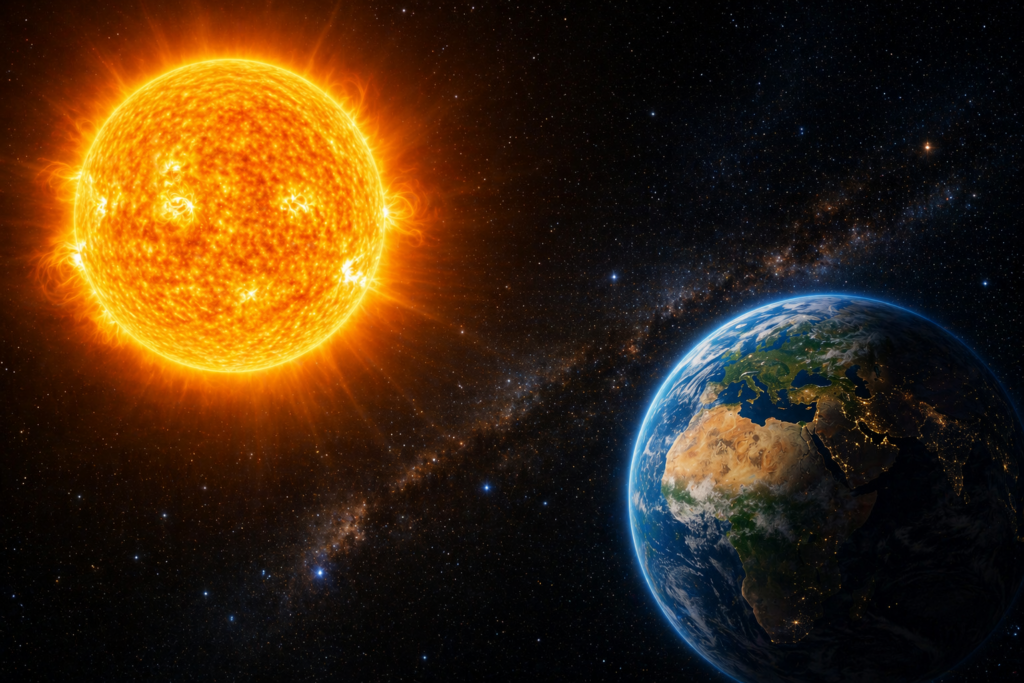
The Sun is essential for life on Earth. Without it, there would be no light, heat, or life.
1. The Sun “burns” without oxygen
On Earth, any fire needs oxygen to burn.
But the Sun is different.
The Sun produces energy through a process called nuclear fusion
- it does not need oxygen
- it produces extremely high temperatures (millions of degrees)
- it releases energy continuously
This is remarkable because it is not like any ordinary fire.
2. Energy travels through cold space
Space is extremely cold (about -270°C).
And yet…
Light and energy from the Sun reach Earth through electromagnetic radiation
- they do not need air
- they travel through empty space
- they reach Earth in about 8 minutes
3. On Earth, it becomes heat
When this energy reaches Earth:
- it is absorbed by land, water, and air
- it is transformed into heat
- it makes life possible
4. What we can learn from this
The Sun:
- operates without oxygen
- sends energy through cold space
- warms the Earth in a way that sustains life
These things show:
- order
- balance
- care for life
“The heavens declare the glory of God.” (Psalm 19:1)
Conclusion
The Sun produces energy without oxygen, sends light through cold space, and that energy becomes heat on Earth, sustaining life.
These realities can be seen as a reflection of God’s care for the Earth and for humanity.
Source:
- NASA
- ESA
- NOAA
- Manuale de astrofizică (ex: „An Introduction to Modern Astrophysics” – Carroll & Ostlie)


Leave a Reply