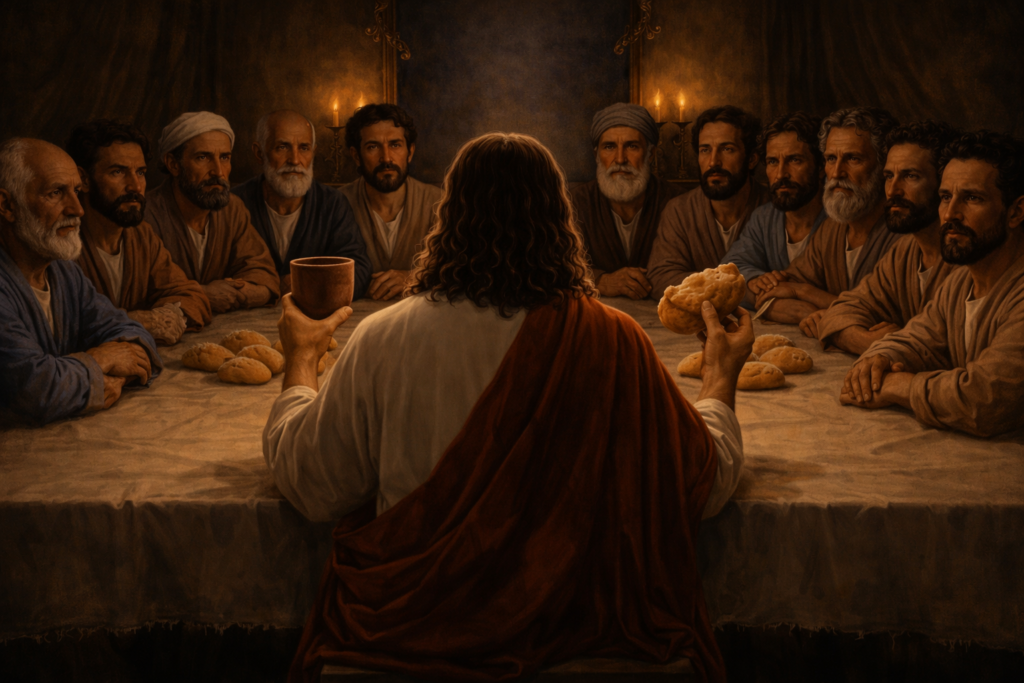
The memorable Last Supper.
John, the son of the Jewish priest Zechariah, pointed to Jesus of Nazareth as the MESSIAH and spoke of Him as THE LAMB OF GOD, WHO TAKES AWAY THE SIN OF THE WORLD.
“Behold the Lamb of God, who takes away the sin of the world!” (John 1:29)
Hundreds of years before John, the prophet Isaiah had compared the coming of the Messiah to a lamb. His own likeness to a lamb signified that He would be killed and put to death in a violent manner.
Isaiah prophesied:
“He was oppressed and afflicted, yet He did not open His mouth at all, like a lamb that is led to the slaughter and like a sheep that is silent before its shearers: He did not open His mouth. He was taken away by oppression and judgment… He was cut off from the land of the living and struck to death for the sins of my people. His grave was assigned among the wicked and His tomb with the rich, although He had done no violence and no deceit was found in His mouth… He will give His life as a sacrifice for sin.”
(Isaiah 53:7–10)
Because the soul of this innocent (blameless) one had been poured out into death for the good of all mankind, the foundation of a new righteous world had been laid in Him.
“…the Lamb who was slain from the foundation of the world.” (Revelation 13:8)
The apostle Paul wrote:
“Sweep out the old leaven, that you may be a new lump, just as you are unleavened; for Christ, our Passover, has been sacrificed for us. Therefore let us keep the feast, not with old leaven…”
(1 Corinthians 5:7–8)
The very fact that Paul calls Christ our Passover requires that Christ Jesus be sacrificed on that very day on which the Jews slaughtered and ate their Passover lamb, namely on the 14th of Nisan, by God’s arrangement. Nisan was the first month of their year.
It is important to understand and recognize this fact, so that each year we may know the proper time to celebrate the memorial of the founding of the new world of righteousness through the death of the Lamb of God.
“On the first day of Unleavened Bread, when they sacrificed the Passover…” (Mark 14:12–14)
“On the first day of Unleavened Bread, the disciples came to Jesus…” (Matthew 26:17–18)
It should therefore be observed that Judas was not present when Jesus instituted the commemoration of something new on the night of the Passover.
“…he went out; and it was night.” (John 13:30)
This fact establishes the principle that the memorial observance is something that must be celebrated only in the evening after sunset and before midnight, and not in the morning or at any other time of the day.
Most accounts show that the memorial of Christ’s death was instituted exactly after the disciples had finished eating the Passover lamb and had thus fulfilled the Law of Moses to which they were bound.
Mark reports:
“While they were eating, Jesus took bread… then He took a cup…”
(Mark 14:22–26)
The Kingdom of God, which Jesus mentioned here as future, is the kingdom of the new world of righteousness, in which Christ Jesus expected to be together with His faithful disciples, to drink the cup there, not of shameful death, but of joy in glory.
Consequently, the memorial observance brings some into relationship with the Kingdom of God through Christ Jesus, and this strengthens the evidence that it is a commemoration of the founding of the new world, in which that glorious kingdom will hold absolute control for the blessing of all mankind.
Without any exception, people agree that the bread which Jesus used at the memorial supper was unleavened bread, since God’s law forbade the use of any other bread during the Passover and during the seven days of the feast that followed.
“You shall not eat leavened bread…” (Exodus 13:3–7)
“The cup of blessing… is it not the sharing in the blood of Christ? The bread… is it not the sharing in the body of Christ?”
(1 Corinthians 10:16–17)
That is, the piece of unleavened bread symbolizes the BODY of Christ, whose head is Jesus. The red wine symbolizes the blood poured out, namely death.
It represents here the death of Christ, by which He proved His integrity and faithfulness to God and by which, at the same time, He paid the ransom sacrifice.
Jesus knew that at His death as the Lamb of God, the Jewish Passover followed by its seven-day feast of unleavened bread would become ineffective or obsolete.
It could no longer serve as a shadow of the good things to come, because the good thing, the better sacrifice, Christ Jesus, had come in reality and had died as a foundation for the new world of righteousness.
To continue celebrating the Passover would mean to give more value to the shadow than to the reality, the substantial thing.
This would show a lack of faith in the coming of Jesus Christ as the Lamb of God who takes away the sin of the world.
“Let no one therefore judge you in regard to food or drink or regarding a festival or a new moon or sabbath days, which are a shadow of things to come, but the body is of Christ.”
(Colossians 2:16–17)
“The Law has a shadow of the good things to come…” (Hebrews 10:1)
“The heavenly things… had to be cleansed with better sacrifices…” (Hebrews 9:23)
“Do this in remembrance of Me…” (1 Corinthians 11:23–26)
The dedicated OTHER SHEEP of the Lord, who are cordially invited to be present at the memorial supper, must not and will not partake of the emblems.
They respect the occasion and respect what it means, as they attend the celebration and observance of what the members of the anointed remnant do in obedience to the instructions of their Head.
But they understand that they are not members of the anointed body of Christ and are not baptized into His death, nor are they called and destined to reign with Him in His heavenly Kingdom.
They seek everlasting life in human perfection on earth under that heavenly Kingdom. For them, to partake of the emblems would represent something that is not true regarding themselves.
Therefore, they must not partake.
Understanding that the world is approaching its final end and that, therefore, the celebration of the memorial supper will not be observed many more times, may we all appreciate our privilege of showing proper gratitude for this blessed occasion this year and in the years that still remain.
Let us remember, as we stand before the gates of entering the new world of righteousness, that this is a commemoration of the founding of that glorious new world.
Wach Tower No. 4, 1948

Leave a Reply