Introduction
Calcium is one of the most important elements for life on Earth. Although it is commonly known for its role in forming bones and teeth, calcium has a much deeper function in the human body. It participates in essential processes such as muscle contraction, nerve signal transmission, and proper cellular function.
The presence and precise role of calcium in the body reveal a remarkable organization within biological systems. For many believers, this order and harmony reflect the wisdom and care of God in creation.
“O LORD, how manifold are thy works! in wisdom hast thou made them all: the earth is full of thy riches.” — Psalm 104:24 (KJV)
Calcium – An Essential Element for Life
Calcium (Ca) is element number 20 in the periodic table and is one of the most abundant minerals in the human body.
In the human body, approximately 99% of calcium is found in bones and teeth, while the remaining 1% circulates in the blood and within cells where it performs vital functions.
Calcium occurs naturally in:
- limestone rocks
- soil
- water
- living organisms
This element is part of the natural cycles that sustain life on Earth.
The Structure of Bones – The Architecture of Life
Human bones are largely composed of a mineral called calcium phosphate, specifically in the form of hydroxyapatite.
This structure provides a remarkable combination of:
- strength
- flexibility
- stability
Because of calcium, the human skeleton:
- supports the weight of the body
- protects internal organs
- enables movement
The skeleton is not simply a rigid structure; it is a living system that continually renews itself.
Calcium and Cellular Function
Beyond its structural role, calcium also performs essential functions at the cellular level.
It participates in:
- muscle contraction
- transmission of nerve impulses
- blood clotting
- communication between cells
Calcium ions act as chemical signals that regulate many biological processes.
For example, when a muscle contracts, calcium is released inside muscle cells to trigger the contraction mechanism.
Calcium Balance in the Body
The body maintains calcium levels within a very precise balance. If calcium levels become too low or too high, serious health problems can occur.
This balance is controlled by:
- hormones
- vitamin D
- the kidneys
- the digestive system
Such fine regulation reveals the complexity and organization of biological systems.
The Bible teaches that God sustains life.
“For in him we live, and move, and have our being.” — Acts 17:28 (KJV)
Calcium in Nature
Calcium is present in many forms throughout nature. It appears in:
- shells and coral reefs
- limestone formations
- marine organisms
- fertile soils
These natural structures demonstrate the role of calcium in building and sustaining life.
For example, coral reefs are largely composed of calcium carbonate, forming ecosystems that support thousands of marine species.
The Order of Creation
The fact that a single chemical element can play such important roles in:
- the structure of the human body
- the functioning of cells
- natural ecosystems
shows how well organized the natural world is.
The chemical properties of calcium are perfectly suited for these roles. If its properties were different, many biological processes would not function properly.
This harmony within nature leads many people to reflect on the wisdom of the Creator.
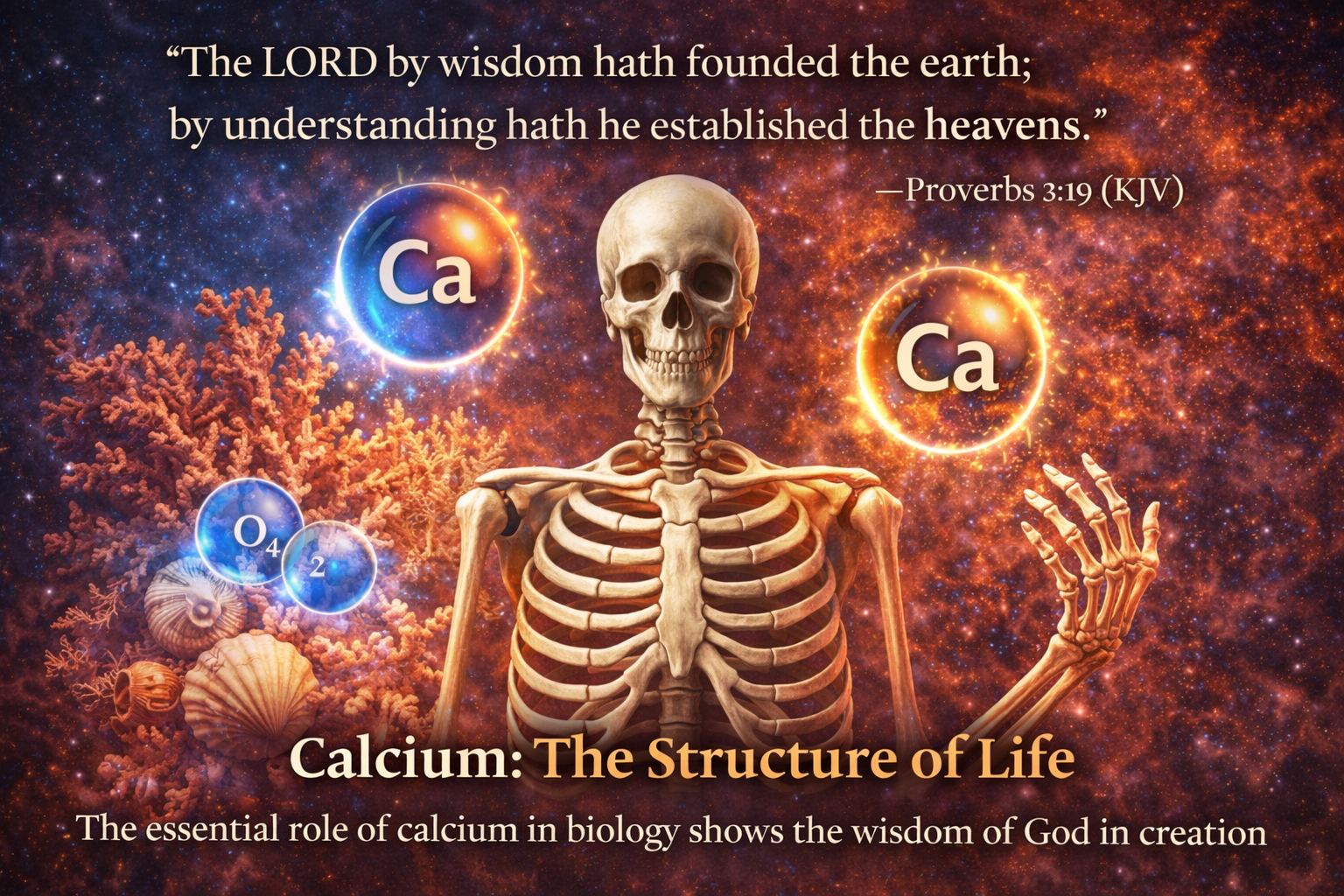
“The LORD by wisdom hath founded the earth; by understanding hath he established the heavens.” — Proverbs 3:19 (KJV)
A Spiritual Lesson
The human skeleton provides stability for the body, and calcium is the element that makes this structure possible.
Just as the skeleton supports the body, Scripture teaches that God sustains all creation.
“Who being the brightness of his glory… upholding all things by the word of his power.” — Hebrews 1:3 (KJV)
Thus, studying nature can become an opportunity to reflect on the wisdom and order present in creation.
Conclusion
Calcium is an essential element for the structure and function of life. It forms bones and teeth, participates in fundamental biological processes, and contributes to the balance of the human body.
Its precise chemical properties and its vital role in living organisms demonstrate the remarkable complexity and harmony of the natural world.
These realities reflect the wisdom and care of God in His creation.
“Know ye that the LORD he is God: it is he that hath made us, and not we ourselves.” — Psalm 100:3 (KJV)
Scientific Sources
- Nelson, D. L., & Cox, M. M. — Lehninger Principles of Biochemistry
- Brown, T. L., LeMay, H. E., Bursten, B. E. — Chemistry: The Central Science
- Petrucci, R. H. — General Chemistry: Principles and Modern Applications
- National Institutes of Health (NIH) — Calcium in Human Health
- U.S. Geological Survey (USGS) — Calcium and Natural Mineral Cycles