Introduction
Table salt, known in chemistry as sodium chloride (NaCl), is one of the most common substances on Earth and one of the most essential for life. Despite its simplicity and familiarity, its formation is a remarkable example of harmony within nature.
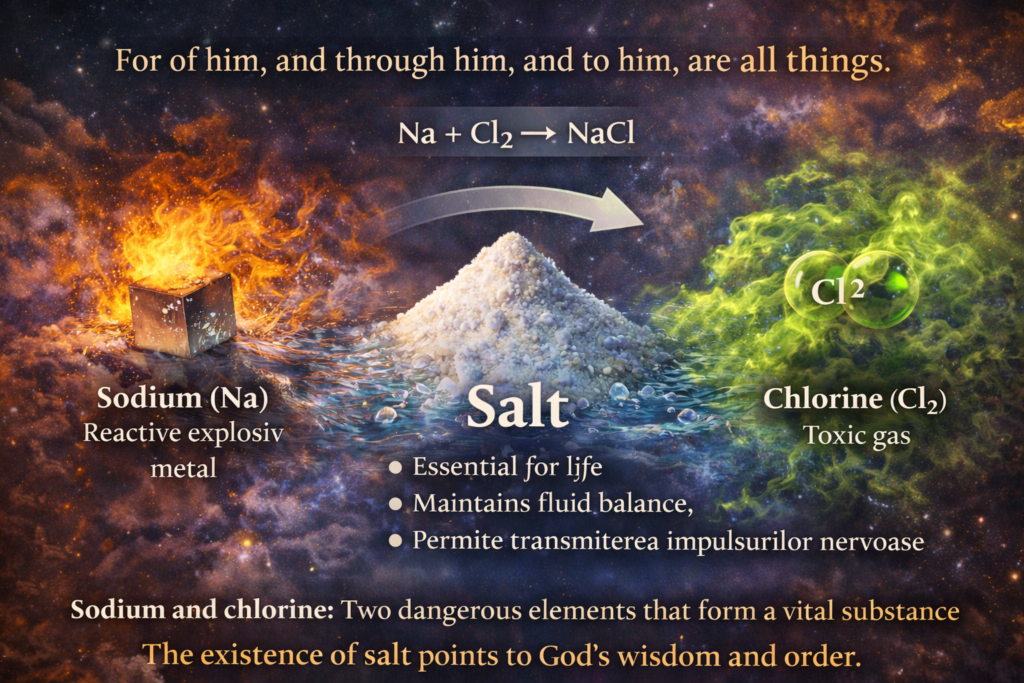
Salt is formed from two elements that, when considered separately, are extremely dangerous: sodium and chlorine. Sodium is a highly reactive metal that can explode in contact with water, while chlorine is a toxic gas harmful to living organisms. Yet when these two elements combine in a precise chemical reaction, they form a stable and life-sustaining compound.
For many believers, this transformation reflects the order, wisdom, and care present in God’s creation.
“O LORD, how manifold are thy works! in wisdom hast thou made them all: the earth is full of thy riches.” — Psalm 104:24 (KJV)
Sodium – A Highly Reactive Metal
Sodium (Na) is an alkali metal found in Group 1 of the periodic table. It is a soft, silvery metal that reacts extremely quickly with other substances.
Important properties of sodium include:
- it reacts violently with water
- it produces hydrogen gas and heat during reactions
- it can ignite or explode when exposed to water
Because of this high reactivity, sodium is never stored in open air. In laboratories it is typically kept under oil, which prevents it from reacting with moisture in the air.
If a piece of sodium is dropped into water, it reacts rapidly, releasing heat and hydrogen gas, sometimes causing a small explosion.
This shows how dangerous sodium can be in its pure elemental form.
Chlorine – A Toxic Gas
Chlorine (Cl) belongs to the group of elements called halogens and exists naturally as a greenish-yellow gas with a strong, irritating smell.
Chlorine has several notable properties:
- it is highly toxic to living organisms
- it reacts easily with many elements
- it is a strong oxidizing agent
Chlorine gas can damage the respiratory system, which is why it was used as a chemical weapon during World War I.
Thus, both sodium and chlorine are potentially dangerous substances when isolated.
The Chemical Formation of Salt
When sodium and chlorine react chemically, the following reaction occurs:
Na + Cl → NaCl
During this reaction:
- sodium atoms lose one electron
- chlorine atoms gain one electron
This transfer of electrons forms an ionic bond, creating a stable compound known as sodium chloride.
The result is astonishing: two dangerous elements combine to produce a safe and essential substance.
Salt no longer has the explosive properties of sodium nor the toxicity of chlorine gas. Instead, it becomes a stable mineral necessary for life.
The Importance of Salt for Life
Salt plays several vital roles in the human body.
It helps to:
- maintain the balance of fluids in the body
- transmit nerve impulses
- allow proper muscle contraction
- regulate cellular processes
Sodium and chloride ions act as electrolytes, which enable electrical signals to travel through nerves and muscles.
Without these ions, the human body would not be able to function properly.
Because of this, salt is essential for maintaining normal physiological processes.
Salt in Nature
Salt occurs naturally in many places on Earth, including:
- oceans and seas
- salt lakes
- underground salt deposits
The oceans contain vast quantities of dissolved sodium chloride. Through geological processes and the water cycle, minerals move through rocks, soil, and water, maintaining the balance of essential elements.
These natural systems ensure that minerals necessary for life remain available.
Salt in the Bible
Salt also carries important symbolic meaning in the Bible. It represents:
- purity
- preservation
- faithfulness
- influence
Jesus said:
“Ye are the salt of the earth.” — Matthew 5:13 (KJV)
In ancient times, salt was extremely valuable because it preserved food and prevented decay. Because of this, it became a symbol of influence that preserves what is good.
Salt was also used in offerings and covenants in the Old Testament, symbolizing permanence and faithfulness.
The Harmony of Creation
The transformation of sodium and chlorine into salt illustrates the remarkable order found in nature.
For salt to form:
- atoms must possess specific properties
- electrons must transfer precisely
- chemical bonds must remain stable
These processes follow universal laws of chemistry that operate consistently throughout the natural world.
Many people see this remarkable order as evidence of design and wisdom in creation.
“The LORD by wisdom hath founded the earth; by understanding hath he established the heavens.” — Proverbs 3:19 (KJV)
A Lesson About the Creator
When we observe nature carefully, we often find that systems are balanced in ways that support life.
The fact that two dangerous elements combine to form a life-sustaining substance illustrates how the natural world operates with remarkable precision.
The Bible teaches that creation itself points to the reality of God.
“For the invisible things of him from the creation of the world are clearly seen, being understood by the things that are made.” — Romans 1:20 (KJV)
Thus, studying nature can lead us to reflect on the wisdom behind the universe.
Conclusion
Sodium and chlorine are dangerous elements when they exist separately. Sodium reacts violently with water, and chlorine is a toxic gas. Yet when these two elements combine through chemical bonding, they form sodium chloride—common salt, a substance essential for life.
This transformation demonstrates the remarkable harmony present in the laws of chemistry.
For many believers, such examples of balance and order in nature reflect the wisdom and care of God in creation.
“For of him, and through him, and to him, are all things: to whom be glory for ever. Amen.” — Romans 11:36 (KJV)
Scientific Sources
The scientific information presented in this study is based on established chemistry and earth science literature, including:
- Brown, T. L., LeMay, H. E., Bursten, B. E., Murphy, C., & Woodward, P. (2018). Chemistry: The Central Science (14th ed.). Pearson.
- Petrucci, R. H., Herring, F. G., Madura, J. D., & Bissonnette, C. (2017). General Chemistry: Principles and Modern Applications. Pearson.
- Atkins, P., & de Paula, J. (2014). Atkins’ Physical Chemistry (10th ed.). Oxford University Press.
- Royal Society of Chemistry. Sodium and Chlorine Chemistry.
- U.S. Geological Survey (USGS). Salt Deposits and Mineral Resources.