Introduction
Nitrogen is one of the most abundant and essential elements for life on Earth. Although it makes up about 78% of the Earth’s atmosphere, nitrogen in its atmospheric form (N₂) cannot be used directly by most living organisms. Yet through a remarkable system known as the nitrogen cycle, this element is continuously transformed into forms that plants, animals, and humans can use.
This cycle demonstrates a highly ordered natural process in which nitrogen moves through the atmosphere, soil, plants, animals, and microorganisms. From a biblical perspective, such balance and order can be understood as part of God’s provision and care for His creation.
“The LORD by wisdom hath founded the earth; by understanding hath he established the heavens.” — Proverbs 3:19 (KJV)
The nitrogen cycle ensures that life continues generation after generation, reflecting a system of remarkable balance within nature.
The Nature of Nitrogen
Nitrogen is the seventh element in the periodic table and exists primarily as a gas (N₂) in Earth’s atmosphere.
Important properties of nitrogen include:
- It is relatively inert, meaning it does not easily react with other substances.
- Two nitrogen atoms are connected by a very strong triple bond.
- Because of this stability, atmospheric nitrogen must be converted before living organisms can use it.
Nitrogen is essential because it forms part of many biological molecules, including:
- amino acids (the building blocks of proteins)
- DNA and RNA (genetic material)
- ATP (the energy molecule of cells)
- chlorophyll (used by plants for photosynthesis)
Without nitrogen, cells could not grow, reproduce, or function properly.
Nitrogen in Living Organisms
Every living organism depends on nitrogen for survival.
In biological systems, nitrogen is found in:
- proteins that build tissues and enzymes
- nucleic acids that carry genetic information
- many cellular structures
For example:
- The muscles of the human body contain nitrogen-rich proteins.
- DNA, which stores genetic instructions, contains nitrogen bases such as adenine, thymine, cytosine, and guanine.
- Plants require nitrogen to grow leaves and produce chlorophyll.
Because of this, nitrogen is one of the most critical nutrients for life on Earth.
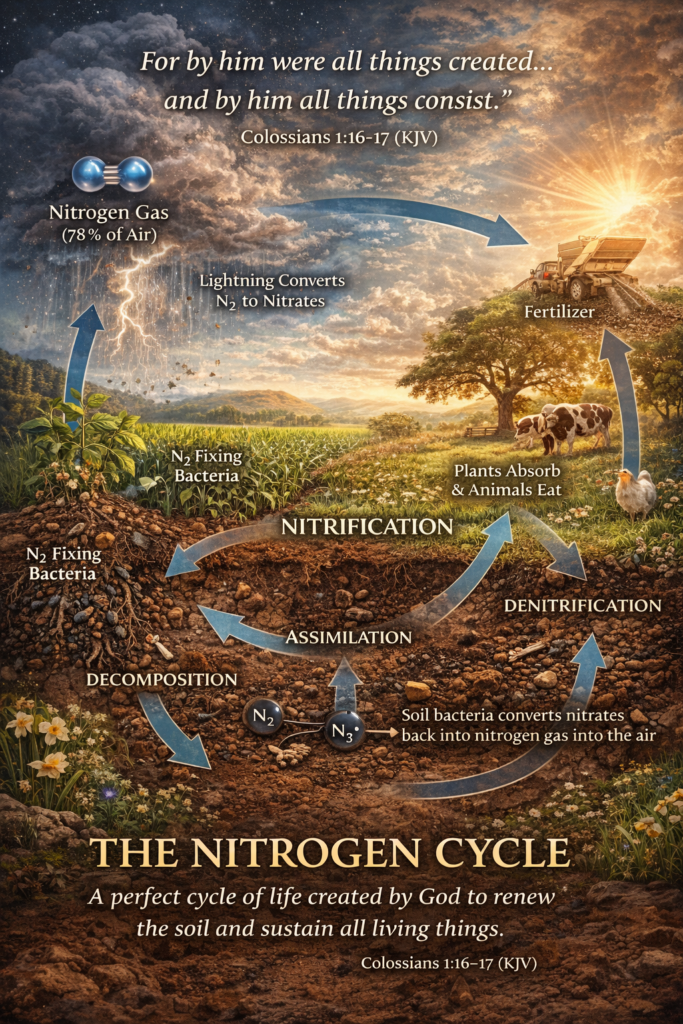
The Nitrogen Cycle
The nitrogen cycle is a natural process that moves nitrogen through different parts of the Earth’s system.
This cycle includes several key stages.
Nitrogen Fixation
Since atmospheric nitrogen cannot be used directly by plants or animals, it must first be converted into usable compounds.
This process is called nitrogen fixation.
Nitrogen fixation occurs through:
- soil bacteria
- lightning
- industrial processes
Certain bacteria living in the soil or in the roots of plants convert nitrogen gas into ammonia (NH₃) or related compounds.
These compounds can then be absorbed by plants.
Nitrification
Once ammonia is present in the soil, other bacteria convert it into nitrites (NO₂⁻) and nitrates (NO₃⁻).
These forms of nitrogen are easily absorbed by plants through their roots.
Plants use nitrates to build proteins and other biological molecules.
Assimilation
Plants incorporate nitrogen compounds into their tissues.
Animals then obtain nitrogen by eating plants or by eating other animals that consumed plants.
Thus nitrogen moves from:
soil → plants → animals → humans
This step allows nitrogen to become part of living organisms.
Decomposition
When plants and animals die, microorganisms break down their tissues.
During this process, nitrogen compounds are released back into the soil as ammonia.
This allows the nitrogen to re-enter the cycle.
Denitrification
Finally, certain bacteria convert nitrogen compounds back into nitrogen gas, returning it to the atmosphere.
This completes the nitrogen cycle.
The cycle then begins again.
The Balance of the Nitrogen Cycle
The nitrogen cycle maintains a delicate balance in nature.
If too little nitrogen were available:
- plants would not grow properly
- ecosystems would collapse
If too much nitrogen accumulated:
- environmental damage could occur
- ecosystems could become unstable
Instead, natural processes regulate nitrogen levels across the planet.
This balance allows life to continue in a stable and sustainable way.
From a biblical perspective, this order reflects the sustaining power of God.
“For by him were all things created… and by him all things consist.” — Colossians 1:16–17 (KJV)
Nitrogen and God’s Provision for Life
The nitrogen cycle also demonstrates how interconnected life is.
Plants depend on soil bacteria.
Animals depend on plants.
Humans depend on both.
Microorganisms ensure that nutrients return to the soil.
This complex system allows life to flourish across the Earth.
Scripture reminds us that God provides for all living creatures.
“These wait all upon thee; that thou mayest give them their meat in due season.” — Psalm 104:27 (KJV)
The nitrogen cycle is one of the many natural systems that make such provision possible.
Order in Creation
Nature contains many cycles that maintain balance, including:
- the water cycle
- the carbon cycle
- the oxygen cycle
- the nitrogen cycle
These cycles interact with one another to sustain life on Earth.
The consistency and reliability of these processes have led many thinkers to recognize the remarkable order present in creation.
The Bible speaks of this order repeatedly.
“He hath made the earth by his power, he hath established the world by his wisdom.” — Jeremiah 10:12 (KJV)
Conclusion
Nitrogen is an essential element for life, forming the foundation of proteins, DNA, and many biological molecules. Although nitrogen is abundant in the atmosphere, it must pass through a carefully balanced cycle before living organisms can use it.
Through processes such as nitrogen fixation, nitrification, assimilation, decomposition, and denitrification, nitrogen moves continuously through the environment.
This cycle ensures that ecosystems remain productive and life continues across generations.
The remarkable balance of the nitrogen cycle reflects a finely ordered system within nature, one that many see as evidence of God’s sustaining care for the world.
“Thou preservest man and beast.” — Psalm 36:6 (KJV)
Scientific Sources
The scientific information in this study is based on established research in chemistry, biology, and earth science, including the following references:
- Nelson, D. L., & Cox, M. M. (2021). Lehninger Principles of Biochemistry (8th ed.). W.H. Freeman.
- Brown, T. L., LeMay, H. E., Bursten, B. E., Murphy, C., & Woodward, P. (2018). Chemistry: The Central Science (14th ed.). Pearson.
- Raven, P., Johnson, G., Mason, K., Losos, J., & Singer, S. (2020). Biology (12th ed.). McGraw-Hill.
- U.S. Geological Survey (USGS). Nitrogen Cycle Overview.
- NASA Earth Observatory. The Nitrogen Cycle and Earth’s Ecosystems.