Introduction
Carbon is one of the most important elements in the universe for the existence of life. Every living organism on Earth—plants, animals, and humans—is built upon complex carbon-based molecules. Modern chemistry and biology reveal that the structure of life depends fundamentally on carbon atoms.
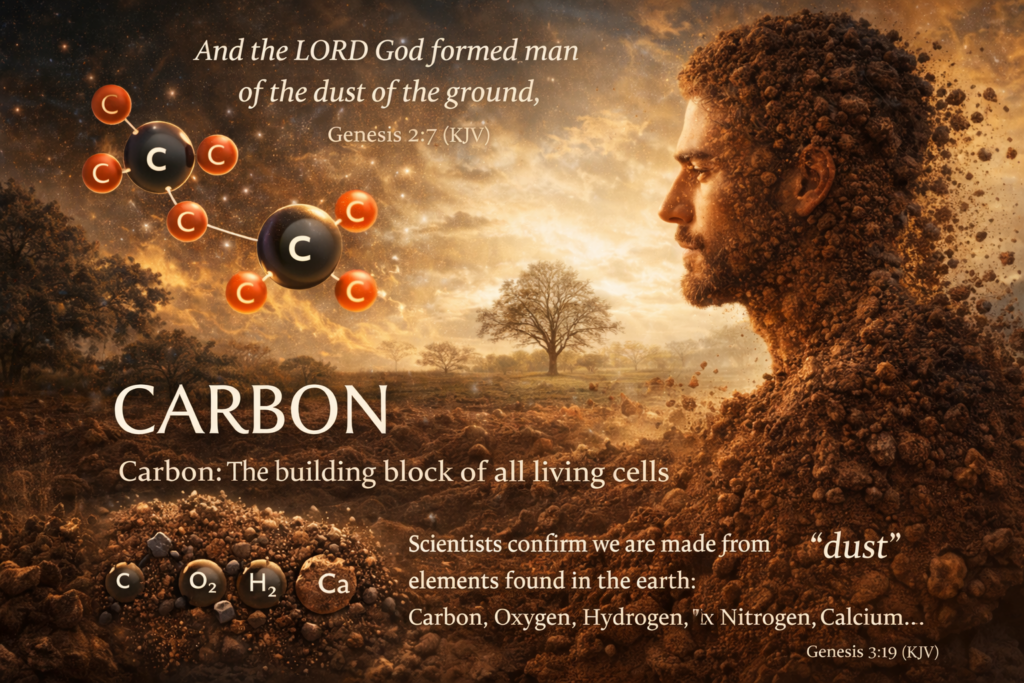
Interestingly, the Bible long ago described the origin of humanity in a way that resonates with this scientific understanding. Scripture teaches that the human body was formed from the dust of the earth, which contains the same chemical elements that compose our bodies today.
“And the LORD God formed man of the dust of the ground, and breathed into his nostrils the breath of life; and man became a living soul.” — Genesis 2:7 (KJV)
This statement aligns remarkably well with the scientific discovery that the human body is composed primarily of elements found in the Earth’s crust and soil, with carbon serving as the foundational element of biological molecules.
The Nature of Carbon
Carbon is the sixth element in the periodic table and has unique chemical properties that make life possible.
Key characteristics of carbon include:
- Atomic number: 6
- Four valence electrons
- Ability to form four stable covalent bonds
Because of this bonding ability, carbon atoms can connect to many other atoms and to each other, forming:
- chains
- rings
- complex three-dimensional structures
These structures create the basis for the molecules that sustain life.
Scientists estimate that millions of organic compounds exist, and nearly all of them depend on the bonding versatility of carbon.
Without carbon, the complex chemistry required for living systems would not be possible.
Carbon as the Foundation of Life
All living organisms are built from four primary classes of carbon-based molecules:
- Proteins
- Carbohydrates
- Lipids
- Nucleic acids (DNA and RNA)
Each of these molecules depends on carbon frameworks.
For example:
- DNA, the molecule that carries genetic information, contains carbon atoms forming the backbone of its structure.
- Proteins, which perform most cellular functions, are built from amino acids containing carbon.
- Carbohydrates, such as glucose, provide energy for cells.
- Lipids form the membranes that surround cells.
Because of these roles, carbon is often called “the element of life.”
The Carbon Composition of the Human Body
Scientific analysis shows that the human body is composed of several elements, most of which are commonly found in the Earth’s soil.
Approximate composition of the human body:
- Oxygen – about 65%
- Carbon – about 18%
- Hydrogen – about 10%
- Nitrogen – about 3%
- Calcium – about 1.5%
- Phosphorus – about 1%
These elements together form nearly all biological tissues.
Carbon alone forms the structural backbone of most molecules in the body.
From a scientific perspective, this means that the physical materials of the human body indeed originate from the same elemental resources present in the Earth.
The Biblical Concept of “Dust of the Ground”
The biblical description of humanity being formed from the “dust of the ground” carries profound meaning.
In ancient language, “dust” referred to the basic material substances of the earth. Modern science now understands that the soil contains many of the same elements that compose living organisms.
Among these elements:
- carbon
- oxygen
- hydrogen
- nitrogen
- calcium
- iron
- potassium
- sodium
These are the same elements required for human biological systems.
Scripture repeatedly reminds humanity of this earthly origin.
“In the sweat of thy face shalt thou eat bread, till thou return unto the ground; for out of it wast thou taken: for dust thou art, and unto dust shalt thou return.” — Genesis 3:19 (KJV)
This passage reflects the cycle of matter in nature: the elements that form living bodies eventually return to the earth.
The Carbon Cycle in Nature
Carbon does not remain fixed in one place. Instead, it moves continuously through a system known as the carbon cycle.
The carbon cycle includes several major processes:
- Photosynthesis
Plants absorb carbon dioxide (CO₂) from the atmosphere and convert it into organic molecules using sunlight.
- Respiration
Animals and humans consume carbon-containing food and release carbon dioxide back into the atmosphere through respiration.
- Decomposition
When organisms die, microbes break down organic matter, returning carbon to the soil and atmosphere.
- Geological processes
Carbon is stored long-term in rocks, fossil fuels, and ocean sediments.
Through these processes, carbon constantly circulates between the atmosphere, biosphere, oceans, and the Earth’s crust.
This system allows life to continue across generations.
Carbon and the Order of Creation
The properties of carbon are extraordinarily well suited for life.
Scientists often note several remarkable features:
- carbon forms stable bonds but can still react chemically
- it can build large complex molecules
- it allows for self-replicating biological systems such as DNA
These characteristics make carbon uniquely suited to support life.
Scripture speaks of the ordered nature of creation and the wisdom behind it.
“The LORD by wisdom hath founded the earth; by understanding hath he established the heavens.” — Proverbs 3:19 (KJV)
From a scientific perspective, the physical properties of elements like carbon allow the universe to support complex biological systems.
Humanity: Earthly Material and Divine Breath
The biblical description of human creation contains two parts:
- The body formed from the dust of the earth
- The breath of life given by God
“And the LORD God formed man of the dust of the ground, and breathed into his nostrils the breath of life; and man became a living soul.” — Genesis 2:7 (KJV)
Scientifically, the human body consists of the same elements found in the earth.
The Humility of Our Origin
The biblical reminder that humans are formed from dust also carries a moral lesson.
“For he knoweth our frame; he remembereth that we are dust.” — Psalm 103:14 (KJV)
Despite humanity’s intellectual achievements, our physical existence remains deeply connected to the basic elements of the earth.
Carbon atoms that form our bodies today may once have been part of:
- plants
- animals
- soil
- or even ancient stars
In this sense, the physical elements of life are part of a vast natural history.
Conclusion
Carbon is the chemical foundation of life on Earth. Its unique bonding properties allow the formation of the complex molecules that build cells, tissues, and living organisms.
Modern science confirms that the human body is composed of the same basic elements found in the earth’s soil, with carbon playing a central role in biological structure.
The biblical description of humanity being formed from the dust of the ground reflects a profound truth about the material composition of life.
While science explains the chemical structure of the human body, Scripture reminds us that life itself ultimately comes from God.
“Know ye that the LORD he is God: it is he that hath made us, and not we ourselves.” — Psalm 100:3 (KJV)
Scientific Sources
The scientific information presented in this study is based on established research in chemistry, biology, and earth science, including the following references:
- Brown, T. L., LeMay, H. E., Bursten, B. E., Murphy, C., & Woodward, P. (2018). Chemistry: The Central Science (14th ed.). Pearson.
- Nelson, D. L., & Cox, M. M. (2021). Lehninger Principles of Biochemistry (8th ed.). W.H. Freeman.
- Petrucci, R. H., Herring, F. G., Madura, J. D., & Bissonnette, C. (2017). General Chemistry: Principles and Modern Applications. Pearson.
- U.S. Geological Survey (USGS). The Carbon Cycle.
- NASA Earth Observatory. Carbon in Earth’s System.