Introduction
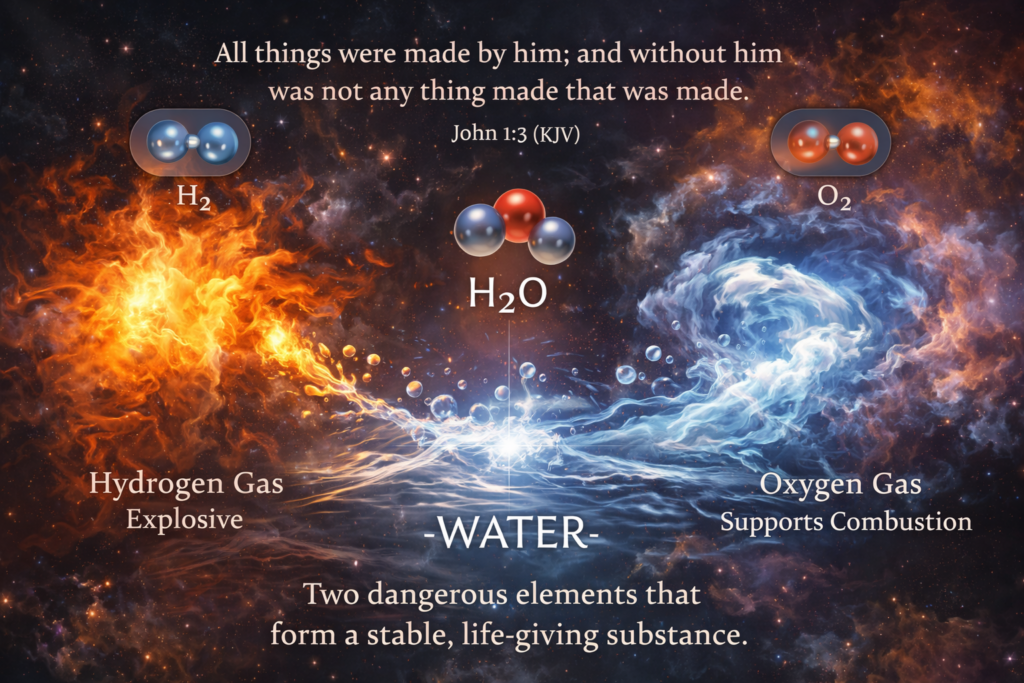
Water is one of the most essential substances for life in the universe. Every known living organism depends on it. Remarkably, water is formed from two elements that, when considered separately, can be extremely dangerous: hydrogen and oxygen.
Hydrogen is highly flammable and explosive, while oxygen strongly supports combustion. Yet when these two elements combine in precise proportions, they form water (H₂O)—a substance that sustains life, regulates climate, and extinguishes fire.
For many believers, this remarkable transformation reflects the wisdom and order embedded in creation. Scripture often points to the intentional design and harmony present in the natural world.
“O LORD, how manifold are thy works! in wisdom hast thou made them all: the earth is full of thy riches.” — Psalm 104:24 (KJV)
The Nature of Hydrogen
Hydrogen is the simplest and most abundant element in the universe. Each hydrogen atom consists of:
- one proton
- one electron
Hydrogen formed shortly after the Big Bang and today makes up most of the matter in stars.
Despite its simplicity, hydrogen has powerful chemical properties. In its molecular form (H₂), hydrogen gas is:
- extremely flammable
- capable of forming explosive mixtures with oxygen
- highly reactive under ignition conditions
When hydrogen mixes with oxygen and an ignition source is present, a rapid combustion reaction can occur. This reaction releases a large amount of energy.
A well-known historical example demonstrating hydrogen’s flammability was the Hindenburg disaster in 1937, when hydrogen gas ignited in the presence of atmospheric oxygen.
From a chemical standpoint, hydrogen carries a tremendous amount of stored energy within its molecular bonds.
The Nature of Oxygen
Oxygen is the third most abundant element in the universe and one of the most important elements for life on Earth.
Key properties of oxygen include:
- it does not burn by itself
- it supports combustion of other substances
- it is essential for cellular respiration
Oxygen composes about 21% of Earth’s atmosphere, and it plays a central role in biological processes. Animals and humans breathe oxygen to release energy from food through metabolic reactions.
In chemistry, oxygen is known as a powerful oxidizing agent, meaning it readily reacts with other elements and compounds.
Without oxygen:
- fire cannot continue burning
- aerobic life cannot survive
The Chemical Reaction that Forms Water
When hydrogen and oxygen combine chemically, they form water through the following reaction:
2H+O → H₂O
This reaction is called a combustion reaction and releases significant energy.
In simplified terms:
- hydrogen provides the fuel
- oxygen enables the reaction
- the result is water and energy
What is striking is that two elements associated with fire produce a substance that quenches fire and sustains life.
From a molecular perspective, the oxygen atom bonds with two hydrogen atoms, forming a stable polar molecule with unique physical and chemical properties.
The Unique Properties of Water
Water possesses several extraordinary characteristics that make life possible.
1. Molecular Stability
Once formed, water molecules are chemically stable under normal environmental conditions. This stability allows water to remain abundant and persistent on Earth.
2. Universal Solvent
Water can dissolve more substances than most liquids. Because of this, it plays a critical role in:
- transporting nutrients in living organisms
- facilitating biochemical reactions
- regulating biological systems
3. Temperature Regulation
Water has a high specific heat capacity, meaning it absorbs and releases heat slowly. This property helps stabilize Earth’s climate and allows organisms to regulate internal temperature.
4. Existence in Three States
Water naturally occurs in all three states of matter on Earth:
- solid (ice)
- liquid (water)
- gas (vapor)
This enables the hydrological cycle, which distributes water around the planet through evaporation, condensation, and precipitation.
Water and the Sustaining of Life
Life as we know it depends on water. The human body is composed of approximately 60% water, and many biological processes occur in aqueous environments.
Water is essential for:
- metabolism
- nutrient transport
- cellular structure
- temperature regulation
It is not surprising that water appears prominently in the biblical account of creation.
“And the Spirit of God moved upon the face of the waters.” — Genesis 1:2 (KJV)
Even at the beginning of the biblical narrative, water is presented as part of the ordered environment prepared for life.
The Harmony of Creation
From a scientific perspective, the interaction between hydrogen and oxygen demonstrates how natural laws allow complex and life-sustaining systems to emerge.
Two reactive elements combine in precise ratios and produce a stable compound vital to biological systems. This balance reflects the remarkable order found in chemistry and physics.
Scripture frequently refers to the wisdom behind creation.
“The LORD by wisdom hath founded the earth; by understanding hath he established the heavens.” — Proverbs 3:19 (KJV)
The natural world often reveals patterns of interdependence and balance that have fascinated scientists for centuries.
Water as a Symbol of Life in Scripture
Beyond its physical importance, water also carries deep symbolic meaning in the Bible. It is associated with:
- life
- purification
- spiritual renewal
- divine blessing
Jesus himself used water as a metaphor for spiritual life.
“But whosoever drinketh of the water that I shall give him shall never thirst.” — John 4:14 (KJV)
This spiritual imagery reflects the universal human understanding that water represents sustenance and renewal.
Conclusion
Hydrogen and oxygen, when observed individually, possess properties that can be hazardous and powerful. Hydrogen is highly explosive, and oxygen intensifies combustion. Yet when these elements combine in the precise proportions dictated by chemical laws, they form water—one of the most life-sustaining substances in existence.
This transformation illustrates the remarkable harmony present in the natural world. The physical laws governing chemistry allow seemingly dangerous elements to interact in ways that produce stability, balance, and life.
For many, this harmony reflects the deeper order of creation described in Scripture.
“For every house is builded by some man; but he that built all things is God.” — Hebrews 3:4 (KJV)
Water is proof of the existence of a wonderful Creator, God.
Scientific Sources
The scientific explanations in this study are based on widely accepted principles of chemistry and physics as described in the following references:
- Brown, T. L., LeMay, H. E., Bursten, B. E., Murphy, C. J., & Woodward, P. (2018). Chemistry: The Central Science (14th ed.). Pearson.
- Atkins, P., & de Paula, J. (2014). Atkins’ Physical Chemistry (10th ed.). Oxford University Press.
- Petrucci, R. H., Herring, F. G., Madura, J. D., & Bissonnette, C. (2017). General Chemistry: Principles and Modern Applications. Pearson.
- National Aeronautics and Space Administration (NASA). Hydrogen and Oxygen in the Universe.
- U.S. Geological Survey (USGS). Water Science School: Properties of Water.